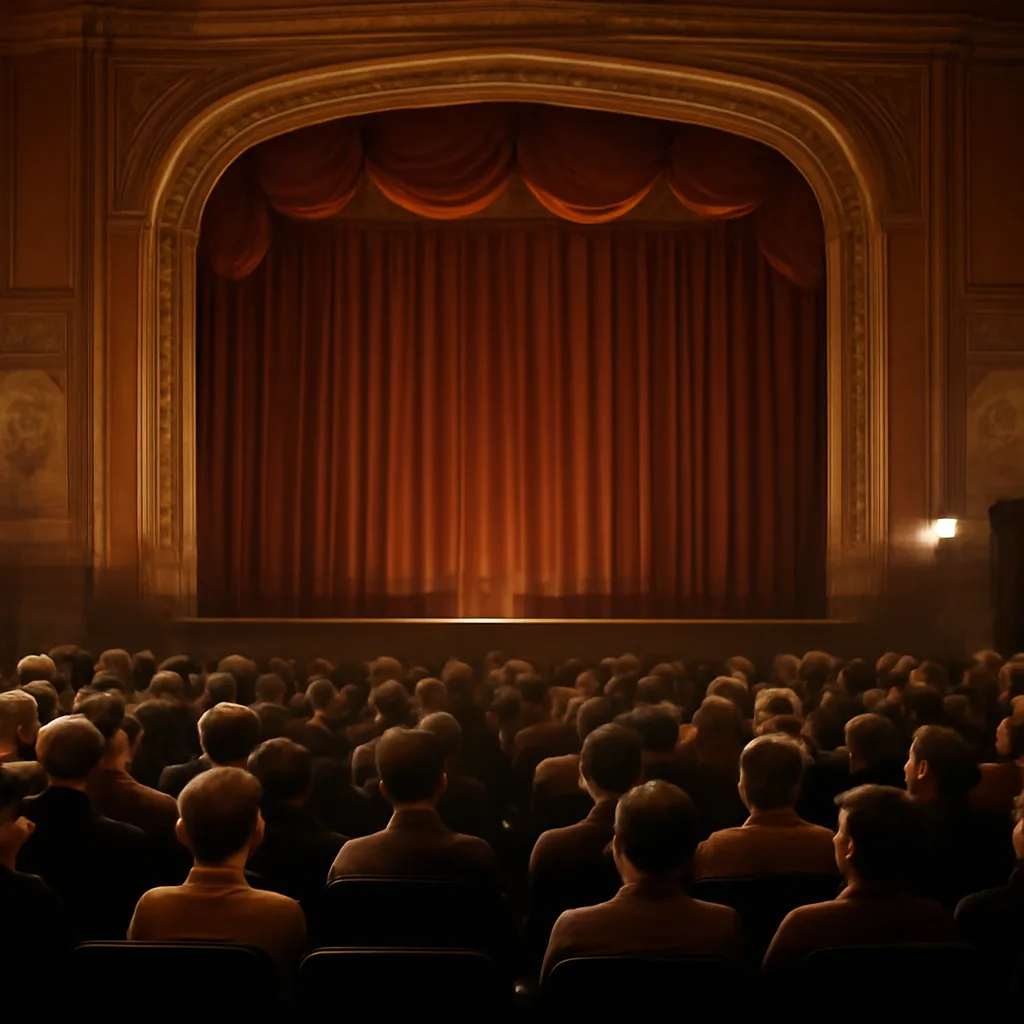
When Sound Met Screen: The First Public Screening of a Synchronized-Sound Film
On April 6, 1927, the public premiere of a feature film using synchronized sound tracks marked a turning point in cinema, introducing audiences to coordinated spoken dialogue and music reproduced with projected images and signaling the decline of the silent-film era.
On April 6, 1927, a public screening widely recognized as the first commercial showing of a feature film with synchronized recorded sound took place, inaugurating a rapid transition in cinema from silent pictures accompanied live to films whose soundtracks were reproduced in sync with the projected image. The date is associated with the public release of The Jazz Singer (1927) in the United States, a Warner Bros. production that used the Vitaphone system to play synchronized musical numbers and several spoken lines by its star, Al Jolson. While The Jazz Singer was not the very first experiment in recorded sound for film, its commercial success and the prominence of synchronized spoken performance in its screenings made April 1927 a watershed moment in the industry's move toward sound films.
Technological background: For years before 1927 inventors and studios experimented with various methods of adding recorded sound to motion pictures, including sound-on-film systems (optical tracks printed directly on the film) and sound-on-disc systems (separate phonograph records played in synchronization with the projector). The Vitaphone system, developed by Western Electric and Bell Telephone Laboratories and adopted by Warner Bros., used large 16-inch phonograph discs synchronized mechanically and electrically with the projector. Early tests and demonstrations of synchronized sound occurred in private and industry settings prior to 1927, but these did not have the same public, commercial impact as the screenings that year.
The Jazz Singer and the April 1927 screenings: The Jazz Singer premiered at the Warner Theatre in New York in late 1927, with its trade and celebrity screenings beginning in October. The April 6, 1927 date is connected in historical accounts to earlier, public demonstrations and to the rollout of synchronized-sound exhibition technology in cities where theaters first installed Vitaphone equipment. Multiple sources place key public exhibitions and premieres of synchronized-sound presentations in 1926–1927 as theaters and studios moved from experimental presentations to commercial releases. The Jazz Singer's widespread release in late 1927 made it the most influential of these early sound films, because it combined synchronized music, singing, and several spoken lines within a feature-length narrative, and because it reached a mass audience.
Impact and reception: Contemporary audiences reacted strongly; newspaper reviews and trade reports noted the novelty of hearing performers’ voices and recorded music precisely matched to on-screen action. The commercial success of synchronized-sound films accelerated investment in sound technology, prompting studios to adopt sound-on-film systems as they matured and to equip theaters with appropriate playback systems. Within a few years, the majority of major studios and urban theaters had converted to sound production and exhibition, and the silent film industry contracted rapidly. The introduction of synchronized sound also affected acting styles, directing, editing, and international distribution practices, since spoken dialogue required new production, translation, and dubbing strategies.
Caveats and historical nuances: Historians caution against a simplistic claim that a single screening on April 6, 1927, alone “started” sound cinema; instead, the shift resulted from cumulative technological development, trade demonstrations, early sound shorts and features, and commercial releases across 1926–1928. Different countries and regions adopted sound technology at different paces. Moreover, several earlier films and demonstrations had used synchronized sound in various forms, but it was the combination of commercial distribution and popular impact—exemplified by late-1927 releases—that decisively transformed the industry.
Legacy: The public screenings and releases of synchronized-sound films in 1927 stand as a turning point in film history. They reshaped cinematic aesthetics, production practices, and the global film market, and they ushered in an era in which recorded sound became an integral, expected component of mainstream motion pictures.