
05/06/1878 • 6 views
Earliest Human Sound Recording Replayed for Public Audience
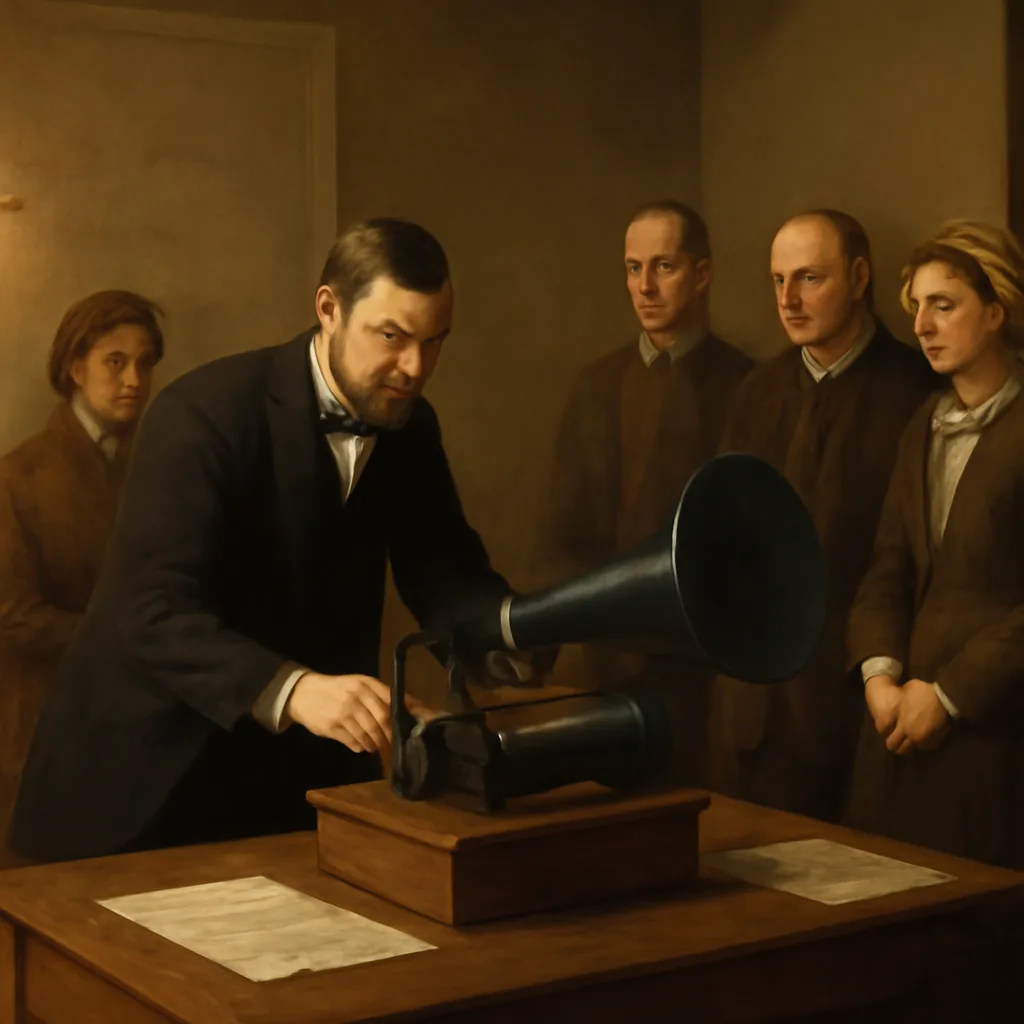
On May 6, 1878, a public replay of what is widely identified as the earliest surviving human sound recording—an etched phonautogram by Édouard-Léon Scott de Martinville—was reported, offering modern listeners a rare acoustic link to the 19th century.
The phonautograph, Scott’s device, used a horn to collect sound and a stylus to inscribe variations onto a moving surface coated with soot. Unlike Thomas Edison’s later phonograph (patented 1877), which produced playable indentations in tinfoil, Scott’s apparatus was conceived as a laboratory instrument for visual analysis of speech and music. For decades the phonautograms were archival artifacts rather than recordings intended for replay.
Accounts surrounding the 1878 replay reflect both technical curiosity and the evolving public fascination with recorded sound. By the late 1870s, inventors and scientists across Europe and the United States were demonstrating or improving devices that could capture and reproduce sound, and public demonstrations were an effective way to show progress. The 1878 event—reported in contemporary press coverage and later discussed by historians of sound—situates Scott’s work in the broader narrative of 19th-century experiments with acoustic inscription.
Historians note some uncertainties about exact provenance and interpretation of specific phonautograms. Identification of a phonautogram as "the first human sound recording" depends on definitions: the earliest surviving inscriptions of human sound by Scott predate Edison’s earliest preserved phonograph cylinders, but Scott himself did not devise a reliable playback method. Modern replays of Scott’s phonautograms have used optical scanning and digital signal processing to convert visible waveforms into audible sound; one widely circulated example—recreated in the 21st century using images of an 1860s phonautogram—brought renewed public attention to Scott’s priority in capturing vocal traces.
The 1878 public replay is significant because it highlights the transitional phase between scientific demonstration and practical playback. It stands as a reminder that the history of recorded sound involved multiple parallel inventions and that ‘‘firsts’’ can hinge on technical definitions: first visual inscription, first replayed inscription, or first device designed to reproduce sound. Contemporary reports of the event encouraged further experimentation and discussion about the possibilities of sound recording and reproduction.
While later historians credit Edison with creating the first widely practical and commercially viable sound-reproducing device, Scott’s phonautograms—and events such as the 1878 replay—are now recognized as foundational steps in the development of acoustic technology. The replay underscored the intellectual continuity from scientific inquiry into acoustics toward machines that could preserve and reproduce the human voice.
Because documentary records from the period can be incomplete or ambiguous, scholars rely on surviving artifacts, laboratory notes, patent records, and press accounts to reconstruct events like the 1878 replay. Where specifics are disputed—such as which exact phonautogram was replayed or the precise technical means used at that time—this summary notes the consensus view: Scott’s phonautograms represent the earliest extant visual captures of human sound, and public demonstrations in the late 1870s helped cement their historical importance in the trajectory leading to audible playback technologies.