
← Back
05/18/1926 • 7 views

First Automated Traffic Control System Tested in 1926
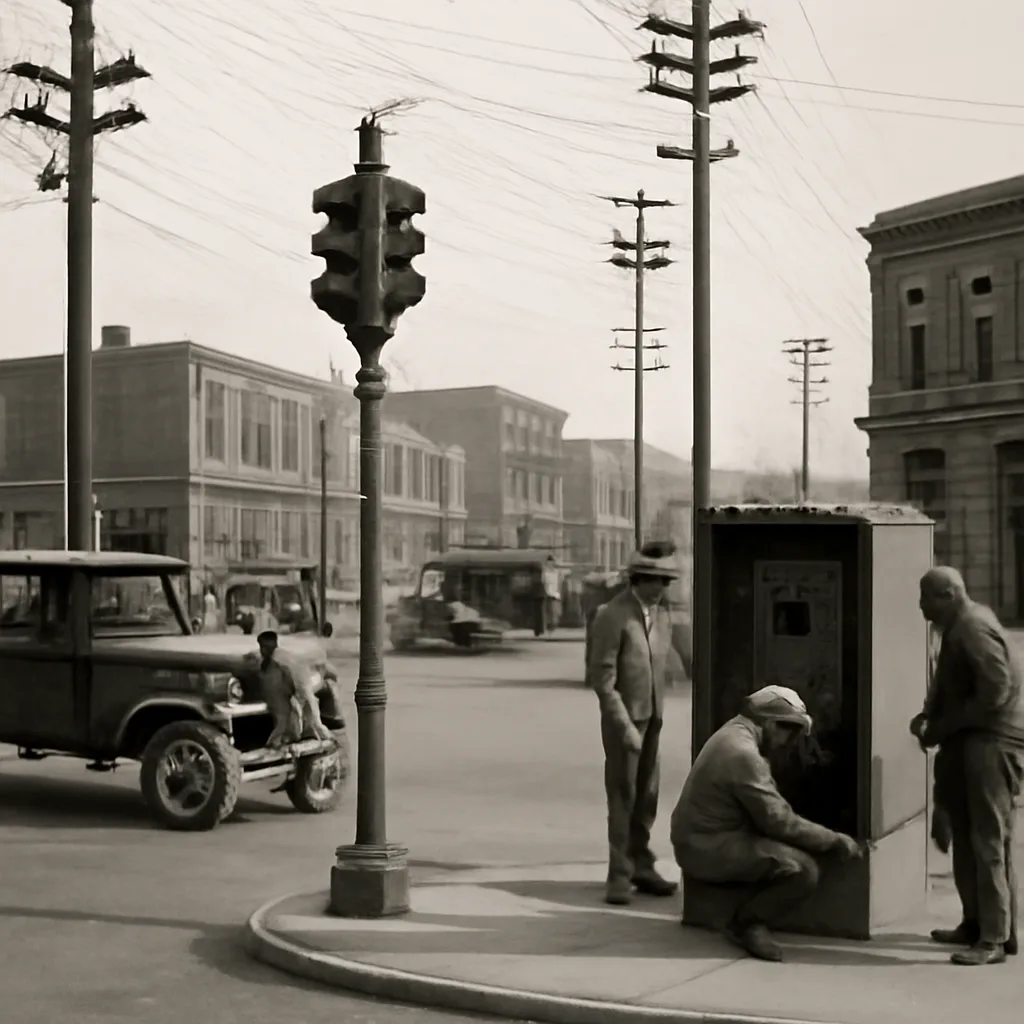
1920s street intersection with early electric traffic signals, utility poles, and cars of the era; engineers examining a control cabinet on the sidewalk.

On May 18, 1926, engineers in Detroit tested an early automated traffic control system combining timed signals and electric switching to regulate vehicle flow — a precursor to modern traffic lights and computerized traffic management.


On May 18, 1926, an experimental automated traffic control system was publicly tested in the United States as municipalities and private companies sought solutions to increasing urban traffic congestion. The test reflected an era when cities were adapting older traffic-signal concepts to the rapid growth of automobiles, experimenting with electrical control and timing mechanisms to move beyond manual police direction and simple mechanically timed signals.

Background

By the 1920s, motor vehicle ownership had surged in many American cities. Early traffic control relied heavily on police officers directing intersections, semaphore arms, or manually operated electric signals. Inventors and municipal engineers pursued automation to improve safety and efficiency. Earlier milestones included the introduction of electric traffic lights (late 1910s) and mechanically timed systems; the 1926 test represented a step toward centralized and automated coordination.

The 1926 Test

Contemporary reports and trade journals describe demonstrations in which electric signal heads were integrated with timing devices and switching mechanisms capable of alternating signals at multiple intersections. The systems under test used electromechanical relays, cam timers or synchronous motors to sequence lights, and in some cases incorporated sensors such as simple pressure-activated switches embedded in the roadway to detect vehicles and modify timing. The demonstration aimed to show how automation could reduce delays, minimize conflicts at intersections, and require fewer human controllers.

Technical features

The tested systems were largely electromechanical rather than electronic by modern standards. Central features included:
- Timed signal cycles driven by synchronous clocks or cam-operated timers.
- Relay-based switching to change signal indications at predetermined intervals.
- Experimental vehicle-actuated devices such as pressure plates or loop-like conductors to alter timing when traffic demand changed.
- Central control panels permitting operators to set cycle lengths and modes for different traffic conditions.

Impact and legacy

Although the 1926 demonstrations did not immediately produce the fully computerized traffic-management centers of later decades, they contributed to wider municipal adoption of coordinated and automated signal systems. Cities that experimented with centralized timing and vehicle actuation during the 1920s and 1930s laid practical and conceptual groundwork for mid-20th-century advances: synchronized corridor timing, remote control by telephone lines, and later, electronics-based controllers and computerized adaptive systems.

Historiography and caveats

Descriptions of a “first” automated system vary by source and depend on definitions: some historians emphasize the first electrically powered lighted signals (earlier, in the 1910s), others the first vehicle-actuated control, or the first coordinated multi-intersection system. The May 18, 1926, date is associated with notable publicized demonstrations of automated control, but multiple parallel experiments occurred in different cities and by private firms. Where contemporary accounts identify specific features (pressure detectors, cam timers, relay logic), later histories link those elements to the lineage of modern traffic control.

Conclusion

The 1926 test was an important episode in the transition from manual and purely mechanical traffic management toward automated, centrally coordinated control. While not the sole or definitive origin of modern traffic systems, the demonstrations that year showcased technologies and operational concepts that shaped subsequent developments in urban traffic engineering.

Share this

Email Share on X Facebook Reddit

Did this surprise you?