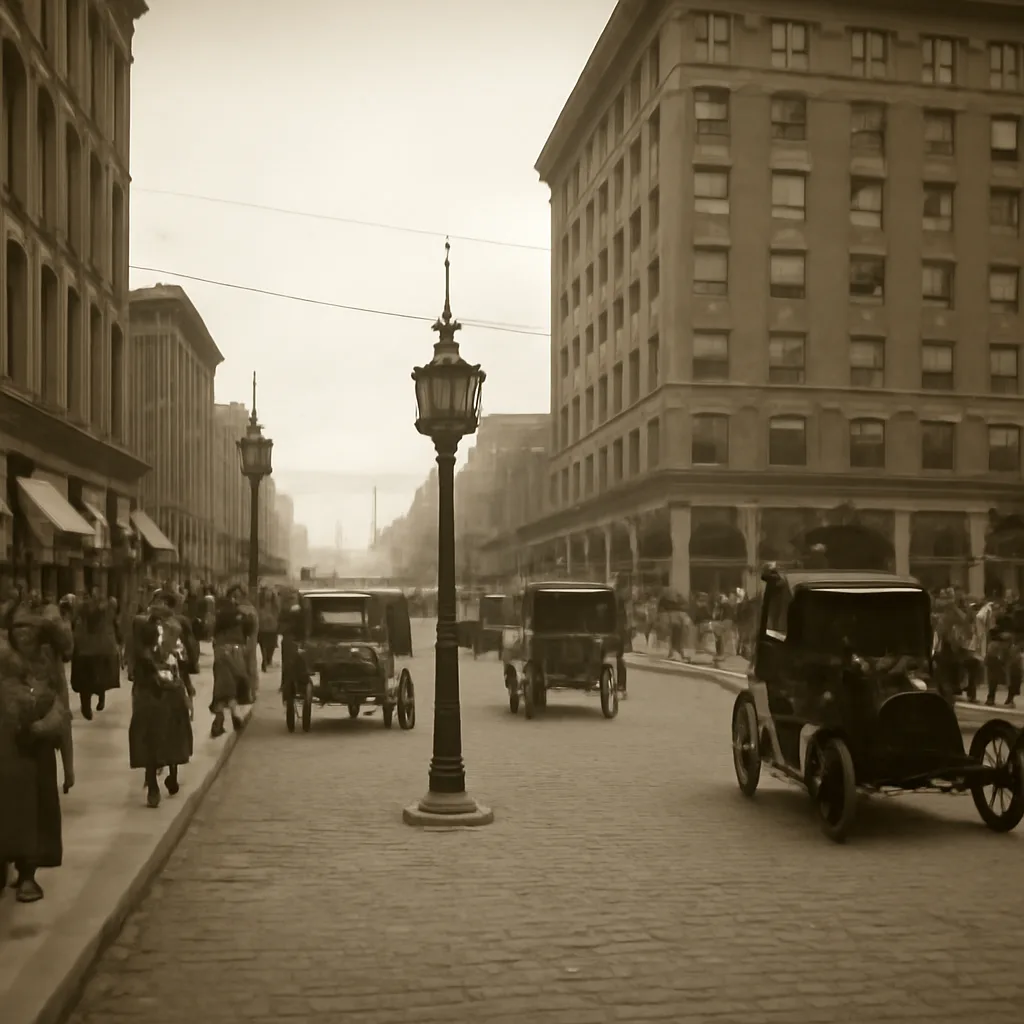
First Electric Traffic Light Installed in Cleveland, 1914
On February 5, 1914, Cleveland, Ohio, saw the installation of what is commonly cited as the first electric traffic light — a two-sided signal mounted outside the Willard Hotel to manage increasingly busy downtown streets.
By the early 20th century, rising automobile traffic and existing manual traffic control methods created frequent congestion and collisions in U.S. cities. On February 5, 1914, Cleveland, Ohio, installed an electric traffic signal outside the Hotel Willard at the intersection of Euclid Avenue and East 105th Street. The device, developed by the American Traffic Signal Company and installed under the direction of Cleveland police, is widely cited in contemporary and later accounts as the first electric traffic light in regular operation.
The apparatus differed from later standardized three-color signals. Early descriptions indicate a two-sided box with red and green lights that alternately indicated “stop” and “go” for traffic, and it was designed primarily to control vehicular flow at a busy downtown location. The signal was mounted on top of a pole and controlled manually by an attendant at first; later iterations of electric signals introduced timing mechanisms and additional indications for pedestrians.
The Cleveland installation built on prior experiments in traffic signaling. In the preceding decade, cities and inventors had tested semaphore arms, gas-lit signals, and police-operated electric signs. For example, London had used semaphore-style traffic control as early as the 19th century, and in the United States there were various mechanical and incandescent-light experiments. What distinguishes the 1914 Cleveland device in many historical accounts is its combination of electric lighting and placement to regulate motor-vehicle traffic in regular public operation.
Historians note that multiple claims exist about “first” traffic signals because of differing definitions (electric vs. mechanical, public vs. experimental, two-color vs. three-color). A related and important milestone came in 1920, when William Potts, a Detroit police officer, is credited with developing the first four-way, three-color traffic signal that more closely resembles modern systems. Nonetheless, Cleveland’s 1914 installation is an early and influential example of electric traffic control and is frequently cited in timelines of traffic-signal development.
The adoption of electric signals proceeded rapidly after early demonstrations. Cities recognized the potential to reduce congestion and accidents, and by the 1920s standardized designs and electric controllers began to appear. These improvements reflected growing municipal engineering capacity and the increasing primacy of the automobile in urban life. Over ensuing decades, traffic-signal technology evolved to include timed cycles, pedestrian indicators, and coordinated networks, but the electric signals of the 1910s mark an important technological and civic response to new urban mobility challenges.
Sources for this summary include contemporary newspaper accounts from Cleveland in 1914 and later historical surveys of traffic-signal development. Because multiple early experiments and regional variations existed, scholars caution against a single definitive “first” without specifying the criteria. The Cleveland installation of February 5, 1914, however, remains a well-documented early instance of an electric traffic light placed into regular public service.