
05/27/1937 • 8 views
Golden Gate Bridge Opens to the Public, May 27, 1937
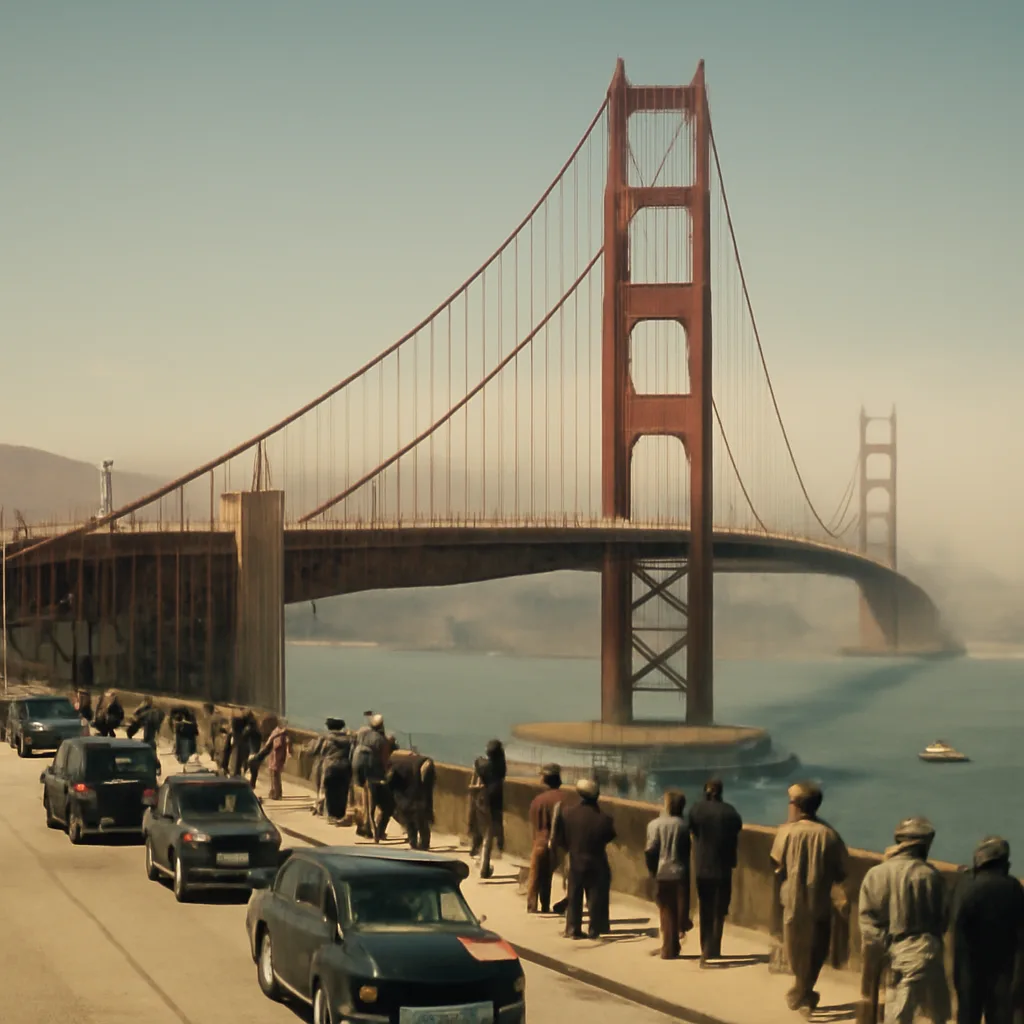
On May 27, 1937, the Golden Gate Bridge in San Francisco opened to the public after four years of construction, marking the completion of what was then the world’s longest suspension span and a transformative feat of engineering and urban connectivity.
At completion the bridge’s main span — 4,200 feet (1,280 meters) — was the longest suspension span in the world, a record that made it one of the most celebrated engineering achievements of the 20th century. Construction proceeded amid challenging conditions: strong currents, deep water, frequent fog, and winds at the strait. Builders used a movable safety net under the bridge deck, which, according to historical records, saved the lives of many workers and became an early and notable workplace-safety innovation for large-scale bridge projects.
The opening was preceded by a week of public celebrations. On May 27th, the bridge was opened to pedestrians for a day-long promenade; an estimated 200,000 people are reported to have walked across the bridge during the celebration, reflecting widespread public interest and civic pride. Motor traffic began the following day. The bridge’s two 746-foot (227-meter) towers and sweeping main cables quickly became an iconic visual landmark for the region.
Beyond aesthetics, the bridge carried significant economic and social impact. It shortened travel between San Francisco and North Bay communities, facilitating commuter movement, trade, and regional integration. The project was funded in part by bond measures approved by voters and constructed under the auspices of the Golden Gate Bridge and Highway District, a public agency established to finance and manage the enterprise.
The bridge also stands within a broader historical context. Erected during the Great Depression, the project provided employment and demonstrated the era’s larger civic ambition to invest in infrastructure. Its engineering drew on contemporary advances in materials, cable-spinning techniques, and structural analysis developed in the early 20th century. Over ensuing decades the Golden Gate Bridge has required ongoing maintenance and retrofitting to address corrosion, seismic risk, and increasing traffic, reflecting the long-term challenges of preserving major waterfront infrastructure.
While the bridge is widely admired, its history also intersects with more difficult topics. Construction and subsequent development affected local maritime patterns and shoreline environments. In later years, the site has become associated with public-health and safety concerns, including traffic congestion and efforts to prevent suicides from the structure, prompting policy and design responses that continue to evolve.
Today the Golden Gate Bridge remains an internationally recognized symbol of San Francisco and an enduring example of large-scale civil-engineering ambition from the 1930s. Its opening on May 27, 1937, is remembered both as a milestone of technical achievement and as a catalyst for the Bay Area’s twentieth-century growth.