
← Back
04/21/1954 • 7 views

Launch of the First Nuclear-Powered Submarine, USS Nautilus
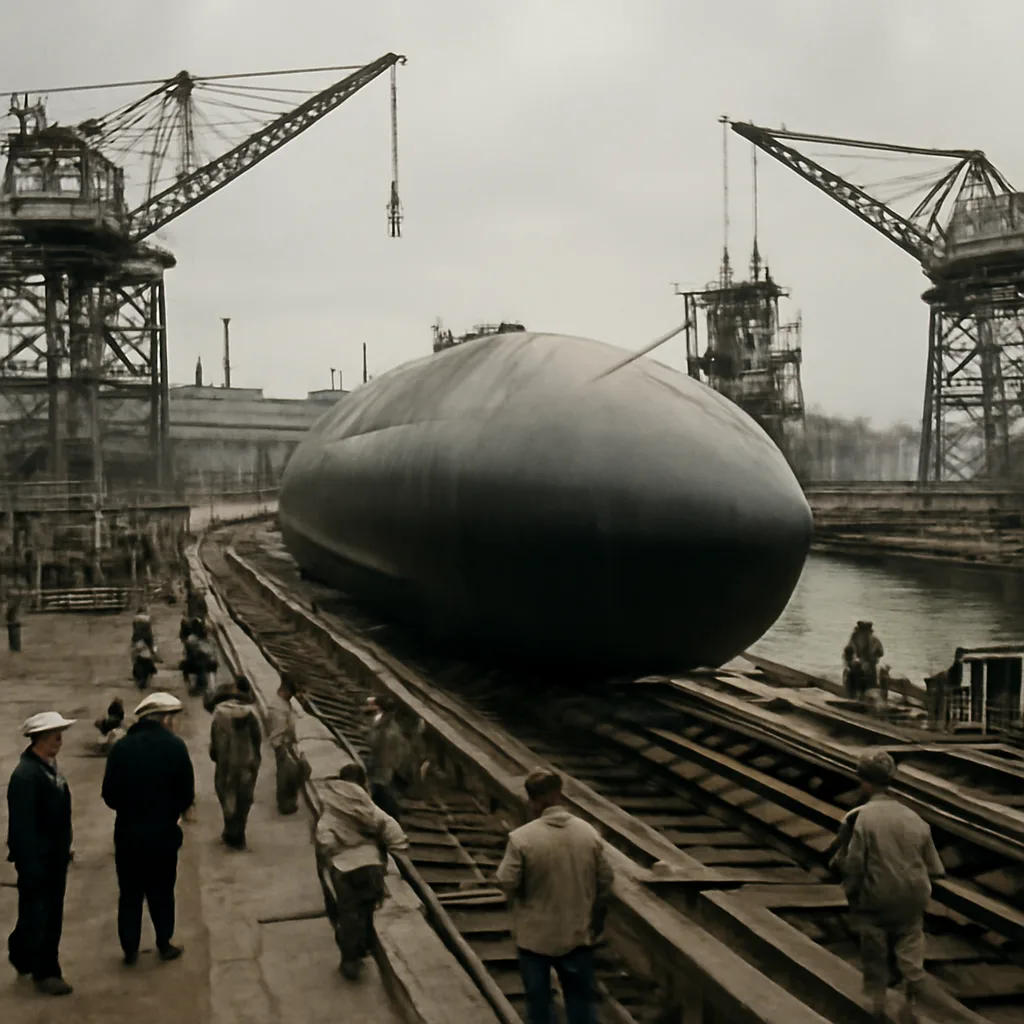
The U.S. Navy submarine USS Nautilus being launched at the Electric Boat shipyard in Groton, Connecticut, April 1954; a large cylindrical hull enters the water with cranes and shipyard buildings in the background.

On April 21, 1954, the U.S. Navy launched USS Nautilus (SSN-571), the world’s first operational nuclear-powered submarine, marking a major advance in naval propulsion and Cold War maritime strategy.


On 21 April 1954 the United States Navy launched USS Nautilus (SSN-571), the world’s first operational nuclear-powered submarine. Designed by the Electric Boat Division of General Dynamics and powered by a pressurized-water nuclear reactor developed under the direction of Admiral Hyman G. Rickover, Nautilus replaced the need for frequent surfacing to recharge batteries and ushered in a new era of sustained submerged operations.

Construction and technical context

Keel-laying for Nautilus took place on 14 June 1952 at the Electric Boat shipyard in Groton, Connecticut. The submarine’s nuclear propulsion plant—a compact pressurized-water reactor—provided a dramatic departure from diesel-electric systems. Nuclear power allowed continuous high-speed steaming underwater limited primarily by crew endurance, food supplies, and maintenance intervals rather than by battery capacity or air requirements for combustion engines.

Launch and commissioning

Nautilus was launched on 21 April 1954 and sponsored by Mamie Eisenhower, wife of President Dwight D. Eisenhower. She was commissioned on 30 September 1954 with Captain H. G. Rickover listed as a key figure in the reactor program (though day-to-day command at commissioning was under command of Commander Eugene P. Wilkinson). The launch was widely reported and framed as both a technological milestone and a strategic asset during the Cold War.

Operational significance

As the first operational nuclear submarine, Nautilus demonstrated capabilities that transformed submarine warfare and naval strategy. Nuclear propulsion enabled prolonged submerged transit, greater sustained speeds, and far longer operational ranges than conventional submarines. These attributes made submarines far more effective for reconnaissance, fleet support, and, later, strategic deterrence when missile-armed submarines entered service.

Public and historical reception

Nautilus’s launch and early voyages attracted public attention as emblematic of American scientific and industrial prowess in the 1950s. The vessel’s most famous peacetime achievement came in 1958 when Nautilus completed Operation Sunshine, the first submerged transit of the North Pole, demonstrating the practical advantages of nuclear propulsion in Arctic waters.

Legacy

Nautilus established the template for subsequent generations of nuclear-powered attack and ballistic-missile submarines. Her success led the U.S. Navy and other navies to prioritize nuclear propulsion for major submarine programs. Nautilus was decommissioned in 1980 and preserved as a museum ship at the Submarine Force Library and Museum in Groton.

Notes on sources and accuracy

The above account summarizes well-documented events in U.S. naval history: launch date (21 April 1954), key technical innovation (pressurized-water reactor propulsion), and subsequent historical milestones such as the 1958 submerged North Pole transit. Specific attributions of roles (e.g., Rickover’s leadership of the reactor program and Wilkinson’s early command) reflect established historical records. Where precise operational details or internal decision-making are complex or debated in scholarship, this summary presents the widely accepted facts without conjecture.

Share this

Email Share on X Facebook Reddit

Did this surprise you?