
← Back
10/01/1949 • 5 views

People's Republic of China proclaimed as Communist Party assumes state control
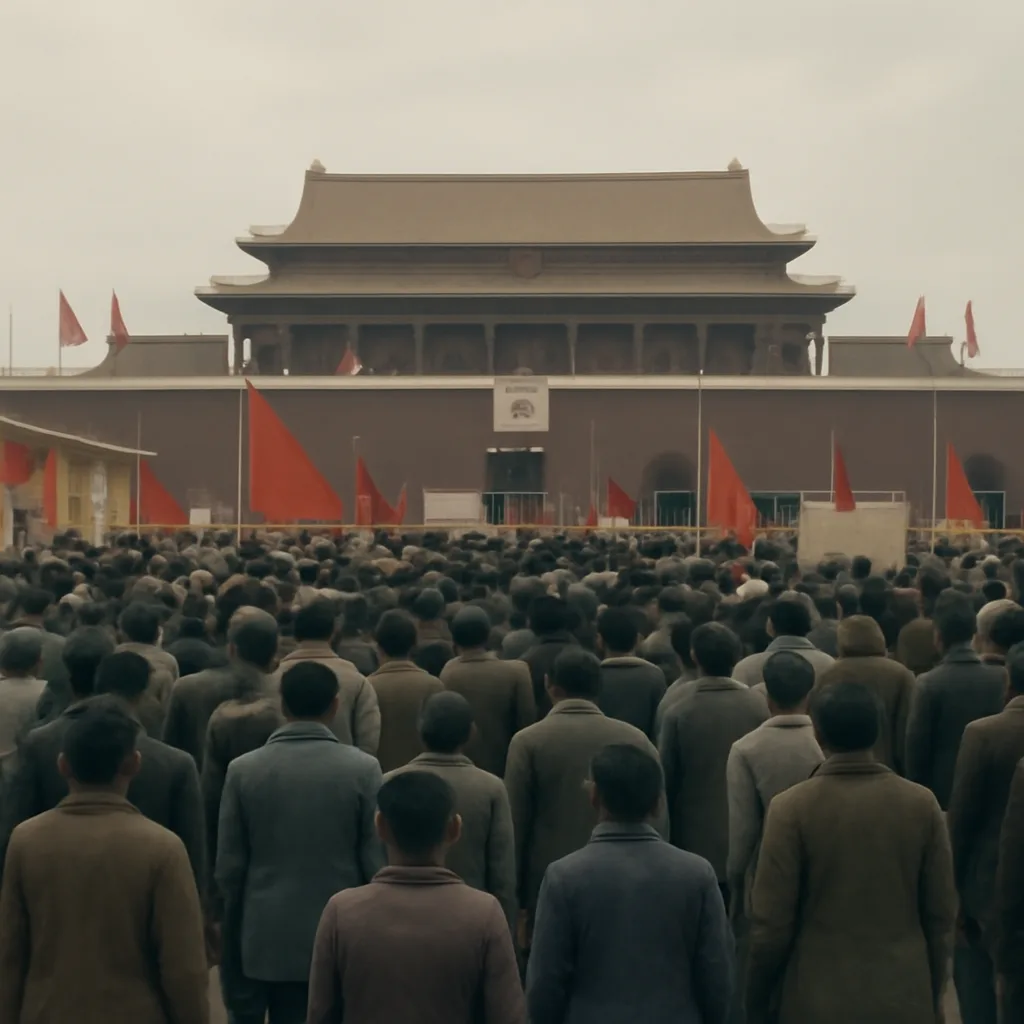
Crowd gathered in Tiananmen Square with banners and flags on October 1, 1949, during the proclamation of the People’s Republic of China; surrounding architecture of central Beijing visible.

On October 1, 1949, Mao Zedong proclaimed the founding of the People's Republic of China in Beijing, marking the Chinese Communist Party's consolidation of state power after years of civil war and the retreat of the Republic of China government to Taiwan.


Background
After years of conflict between the Chinese Communist Party (CCP) and the Nationalist Kuomintang (KMT), China emerged from the Second Sino-Japanese War (1937–1945) into an intensified civil war. By 1949, Communist forces had gained decisive military and political ground across the Chinese mainland. The KMT government, led by Chiang Kai-shek, evacuated many central institutions and eventually relocated to Taiwan.
The proclamation
On October 1, 1949, in Tiananmen Square in Beijing, Mao Zedong read the proclamation establishing the People’s Republic of China (PRC). The ceremony—attended by thousands and widely publicized—declared that the CCP was now the governing authority of the Chinese mainland, replacing the Nationalist government as the effective sovereign power in most of China’s territory.
Consolidation of control
Following the proclamation, the CCP moved to consolidate state control through the establishment of new governing institutions, land reform campaigns, and the reorganization of the military into the People’s Liberation Army under party leadership. Local and provincial administrations were brought into alignment with policies set by the central party leadership. The CCP combined party structures with state organs to create a system in which the party exercised decisive authority over government policy and personnel.
Domestic and international impact
Domestically, the change marked the start of major political, economic, and social campaigns aimed at transforming Chinese society along socialist lines—initiatives that would unfold over the subsequent decades. Politically, many former Nationalist supporters fled to Taiwan or were integrated, suppressed, or removed from positions of influence on the mainland.
Internationally, the PRC’s founding reshaped geopolitics in East Asia. The United States and several other countries continued to recognize the Republic of China (ROC) government in Taipei as China’s legitimate government for years, while the Soviet Union and other communist states established relations with Beijing. Diplomatic recognition shifted over the following decades, culminating in the United Nations’ 1971 vote admitting the PRC and replacing the ROC.
Historical interpretation
Historians note that the October 1, 1949 proclamation formalized a political reality: the CCP’s effective control over most of China’s territory and state apparatus. Scholars also emphasize that the transition involved complex local negotiations, varied regional experiences of CCP authority, and continued contestation in areas not controlled by the new regime. Debates persist about the social and economic consequences of early PRC policies, which scholars study using archival sources, memoirs, and contemporaneous reporting.
Continuities and consequences
The PRC’s founding set the framework for a political system in which the Communist Party holds central authority over the state. Over time, the party–state model established in 1949 evolved through campaigns, reforms, and leadership changes, but the foundational event of October 1 remains a key reference point for understanding modern China’s political development.
Notes on sources and scope
This summary synthesizes widely documented historical facts about the October 1, 1949 proclamation and its immediate consequences. It avoids conjecture about individual motives and does not include fabricated quotations or unverifiable assertions.

Share this

Email Share on X Facebook Reddit

Did this surprise you?