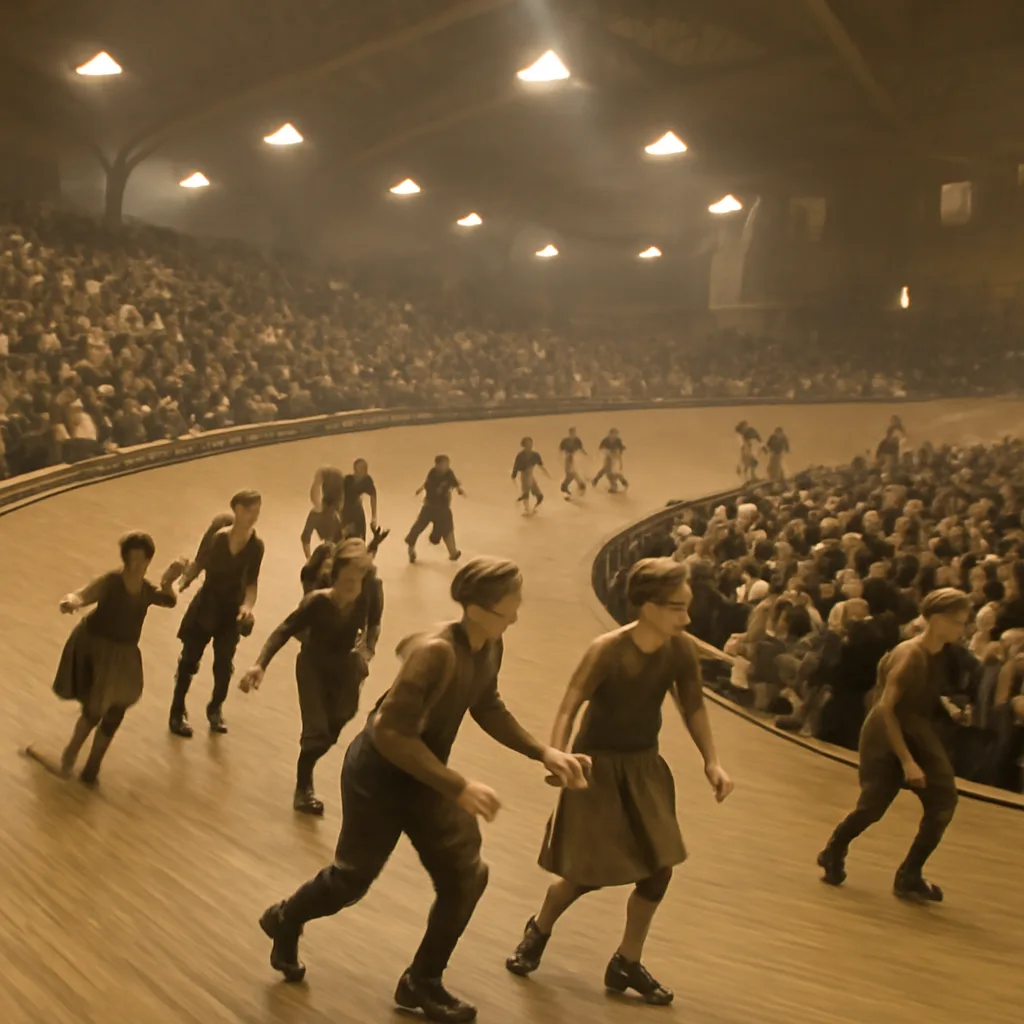
Roller Derby Debuts with First Match in Chicago, April 1935
On April 13, 1935, promoter Leo Seltzer staged what is widely regarded as the first roller derby match at Chicago's Chicago Coliseum, initiating a new spectator sport that combined speed, endurance and staged competition.
On April 13, 1935, promoter Leo Seltzer presented a two-day endurance roller-skating event at the Chicago Coliseum that included an exhibition match now widely cited as the first roller derby contest. Seltzer, a Chicago-area promoter with experience in roller-skating marathons and public spectacles, conceived an event that would transform endurance skating into a team-based, spectator-friendly competition. The April 1935 program featured male and female skaters on banked tracks and attracted newspaper coverage and paying spectators.
The event grew out of a 1920s–1930s culture of endurance contests and skating marathons, which were popular during the Great Depression as inexpensive entertainment. Seltzer’s innovation was to stage teams and dramatize competition to make the spectacle more appealing to crowds and radio audiences. Early accounts describe teams of skaters paired into men’s and women’s squads who skated laps in a relay-like format; the emphasis was both on distance and on crowd-pleasing rivalries. Contemporary reporting and later histories credit Seltzer with packaging the spectacle as “roller derby,” a name that evoked contact and competition and set it apart from traditional figure and speed skating.
Documentation from newspapers, trade publications and later oral histories indicates that the 1935 event was not yet the fully choreographed, contact-heavy form of roller derby that developed in later decades. Early matches emphasized endurance and continuous skating over several hours, with elements of staged drama introduced gradually. Over subsequent years Seltzer and other promoters incorporated rule changes, scripted moments and faster, more collision-oriented skating, culminating in the popular, theatrical form of roller derby that gained national attention in the 1940s and beyond.
Scholars and sports historians generally identify the April 1935 Chicago Coliseum program as the practical origin point for roller derby as a spectator sport, while acknowledging that the activity evolved from earlier skating marathons and exhibition races. Sources vary on details such as the exact lineup of skaters, the structure of the initial matches and how much of the early competition was scripted versus genuine athletic contest. Because contemporaneous coverage sometimes used different terms and because promoters adapted formats quickly to suit audiences, precise boundaries between marathon skating events and the first true “roller derby” are subject to interpretation.
What is clear, however, is that Seltzer’s promotion tapped into contemporary tastes for endurance spectacles and team rivalry, and that the April 1935 event served as a launching point. From Chicago the idea spread through regional circuits, radio broadcasts and later national tours, influencing how organizers staged matches, cultivated personalities and presented the sport to fans. Roller derby’s lineage from Depression-era entertainment to a midcentury mainstream attraction illustrates the sport’s hybrid nature: part athletic contest, part theatrical performance, and part business innovation.
Researchers relying on newspaper archives, trade periodicals and later retrospective interviews should note the limitations of primary sources from the 1930s. Reporting conventions, promoter publicity and fragmentary record-keeping all affect the surviving record. For readers seeking primary documentation, contemporary Chicago newspapers and period skating trade publications from April 1935 are useful starting points; secondary histories of roller derby provide context and analysis of how the sport’s format changed after its debut.
In sum, the April 13, 1935 event at the Chicago Coliseum is widely regarded as the first roller derby match in the sense that it introduced team-based, spectator-focused roller-skating competition branded as roller derby. Its exact contours are debated among historians, but its role as the formative moment in the sport’s public evolution is well established.