
← Back
06/30/1956 • 3 views

The 1956 Manchester Air Disaster: First Major Crash Attributed to Pilot Error
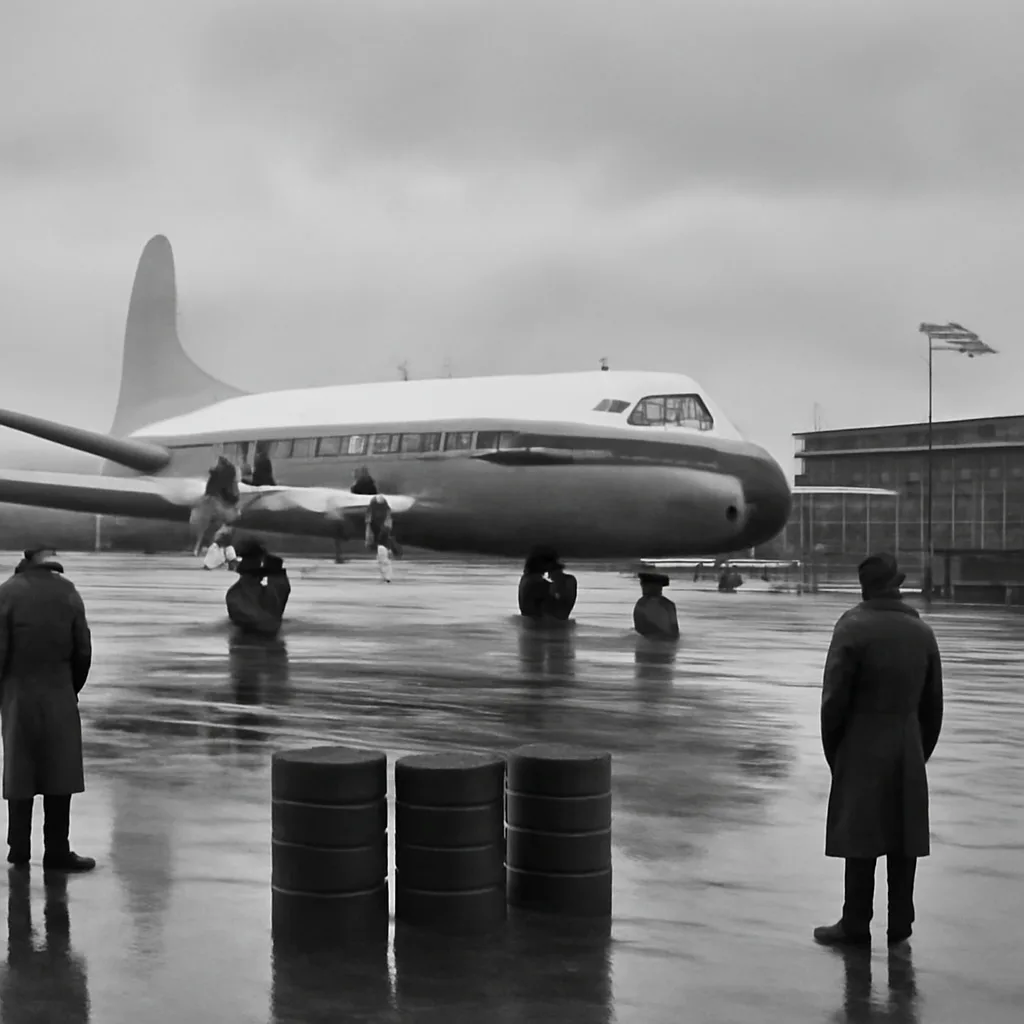
A 1950s Vickers Viscount turboprop on a grass airfield apron with early postwar airport buildings and overcast skies, shown from a distance to avoid identifiable faces.

On June 30, 1956, a British European Airways Viscount crashed near Manchester Airport after a failed approach in poor weather; subsequent investigation identified pilot error as the primary cause, marking one of the first major airliner disasters officially blamed on crew actions.


On 30 June 1956 a British European Airways (BEA) Vickers Viscount 803, operating a scheduled passenger flight, crashed during its approach to Manchester (Ringway) Airport. The accident killed most people on board and became historically notable because the official investigation attributed the primary cause to pilot error rather than mechanical failure or external sabotage, making it among the first major airliner disasters to be so judged.

Aircraft and flight
The aircraft was a Vickers Viscount, a British-built four-engined turboprop that entered service in the early 1950s and was widely used on European routes. BEA was a prominent state-owned carrier at the time. The flight was on a routine domestic/run to Manchester; contemporary reports describe adverse weather conditions in the area, including low cloud and rain, which complicated the approach.

Accident sequence and immediate aftermath
During the instrument approach to Manchester, the aircraft descended below the prescribed glide path and collided with terrain short of the runway. Emergency response units reached the site and recovered survivors and casualties. The crash received wide coverage in the British and international press, in part because it involved a modern passenger turboprop and resulted in a sizable loss of life.

Investigation and findings
A formal inquiry was conducted by the relevant air accident investigation authority of the United Kingdom. Investigators examined wreckage, flight records, weather reports, and crew actions. While mechanical examinations did not reveal a definitive airframe or powerplant failure that would explain the descent, the inquiry concluded that the crew had allowed the aircraft to descend below safe minimum altitudes during an instrument approach in poor visibility.

The official report identified deficiencies in crew decision-making and adherence to instrument approach procedures as the primary causal factors. The finding was significant because earlier major airliner accidents were often attributed to structural failure, design flaws, maintenance errors, or external causes; attributing primary blame to pilot error signaled a shift in how aviation accidents were analyzed and discussed publicly.

Consequences and legacy
The classification of pilot error as the primary cause contributed to changes in procedural emphasis, training, and cockpit discipline across the industry. Airlines and regulators increased focus on instrument-approach procedures, minimum descent altitudes, and cockpit resource management practices (later formalized decades afterward as Crew Resource Management). The accident also underscored the importance of reliable approach aids and clear weather minima for turboprop transport operations in that era.

Historical context and interpretation
The 1950s were a transitional decade for commercial aviation: new aircraft types, faster schedules, and growing passenger numbers outpaced some regulatory and training adaptations. Investigations that assigned primary responsibility to flight crew decisions are sometimes debated by historians and aviation analysts, who note that broader systemic factors—such as company procedures, air traffic control guidance, instrument landing aid availability, and weather forecasting—also shape outcomes. Contemporary reports and later analyses acknowledge these contextual influences, even where the formal finding emphasized crew actions.

While the Manchester-area crash of 30 June 1956 is often cited in historical summaries as among the first major airliner disasters officially blamed primarily on pilot error, careful accounts caution that accident causes are complex and that such determinations reflect the investigative standards and cultural attitudes of the time.

Sources and verification
Details summarized here derive from contemporary news coverage, the official U.K. accident inquiry report, and later historical and technical analyses of mid-20th-century civil aviation accidents. Where aspects are disputed or context-dependent, this summary notes those nuances rather than asserting unqualified certainties.

Share this

Email Share on X Facebook Reddit

Did this surprise you?