
01/07/1914 • 6 views
Panama Canal Opens for Commercial Traffic
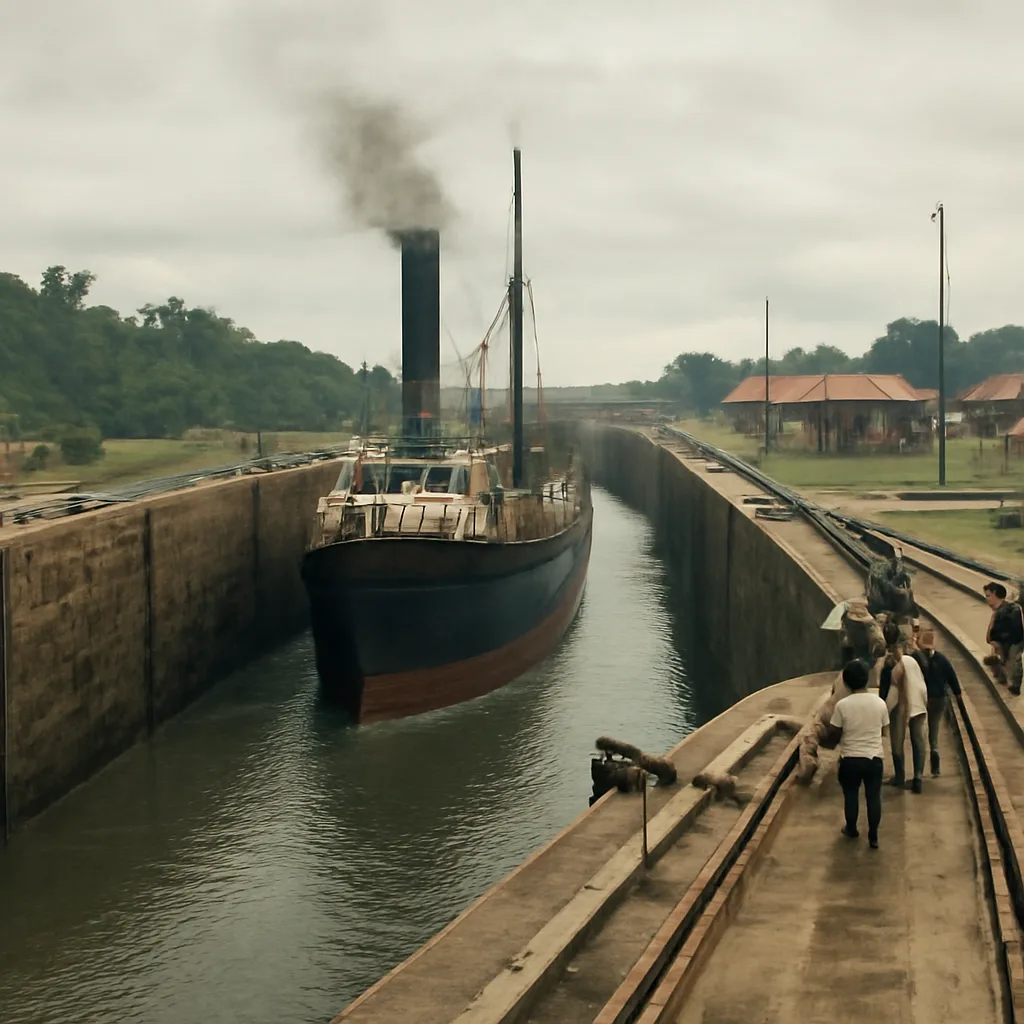
On January 7, 1914, the Panama Canal officially opened to commercial traffic with the passage of the cargo ship SS Cristobal, marking the completion of a project that reshaped global maritime trade by linking the Atlantic and Pacific Oceans.
Early efforts to cross the isthmus with a canal began in the colonial era and were later pursued by the French under Ferdinand de Lesseps in the 1880s. The French attempt collapsed amid engineering challenges, tropical disease, and financial scandal. The United States assumed control of the project after supporting Panama’s separation from Colombia in 1903 and securing rights to build and operate the canal through the Hay–Bunau-Varilla Treaty. Under U.S. administration, large-scale sanitation and engineering programs—many led by engineers such as John F. Stevens and later George W. Goethals—recast the undertaking. Efforts to control yellow fever and malaria, directed by Dr. William C. Gorgas, significantly reduced mortality among workers and made the project feasible.
Construction completed a complex system of locks, dams, and artificial lakes. Rather than a sea-level canal, engineers opted for a lock-based design that raised ships up to Gatun Lake and lowered them again, simplifying excavation through the mountainous continental divide and reducing the required volume of earth removal. Key components included the Gatun Locks on the Atlantic side, the Pedro Miguel and Miraflores Locks on the Pacific side, and the damming of the Chagres River to form Gatun Lake, which provided both water for lock operation and a navigable passage across the isthmus.
On January 7, 1914, the cargo ship SS Cristobal of the Panama Railroad Company completed the first official commercial transit under the authority of the Canal Zone administration. The event followed the transit of the SS Ancon on August 15, 1914, often noted in some accounts as the canal's ceremonial opening to larger public notice; however, the Cristobal’s January passage is documented as the first official commercial transit. The opening immediately began to alter global shipping patterns: voyages between the east and west coasts of the Americas, and between Europe and the west coast of the Americas or East Asia, were shortened by thousands of nautical miles, saving time and cost and changing strategic naval considerations.
The canal’s construction and opening came at a heavy human cost. Tens of thousands of workers—coming from the United States, the Caribbean, Europe, and elsewhere—laboring under difficult tropical conditions contributed to the project; disease and accidents claimed many lives, a legacy that has been the subject of historical research and commemoration. Economically and geopolitically, the canal elevated the strategic and commercial importance of the United States in the Western Hemisphere and prompted changes in maritime commerce, ship design, and international naval strategy.
The Panama Canal operated under U.S. control for most of the 20th century. Control of the canal and the surrounding Canal Zone became a persistent issue in Panamanian–U.S. relations, leading to negotiations that culminated in the Torrijos–Carter Treaties of 1977. Those treaties provided for progressively increasing Panamanian authority and full Panamanian control of the canal, which was achieved on December 31, 1999. Since its opening in 1914, the canal has undergone expansions and technological upgrades, including the addition of new, larger locks completed in 2016 to accommodate bigger vessels, reflecting the waterway’s continuing importance to global trade.
The opening of the Panama Canal on January 7, 1914, stands as a landmark in engineering history and global commerce—an outcome of decades of effort that transformed maritime routes, international relations, and the economies connected by the world’s oceans.