
← Back
01/07/1610 • 2 views

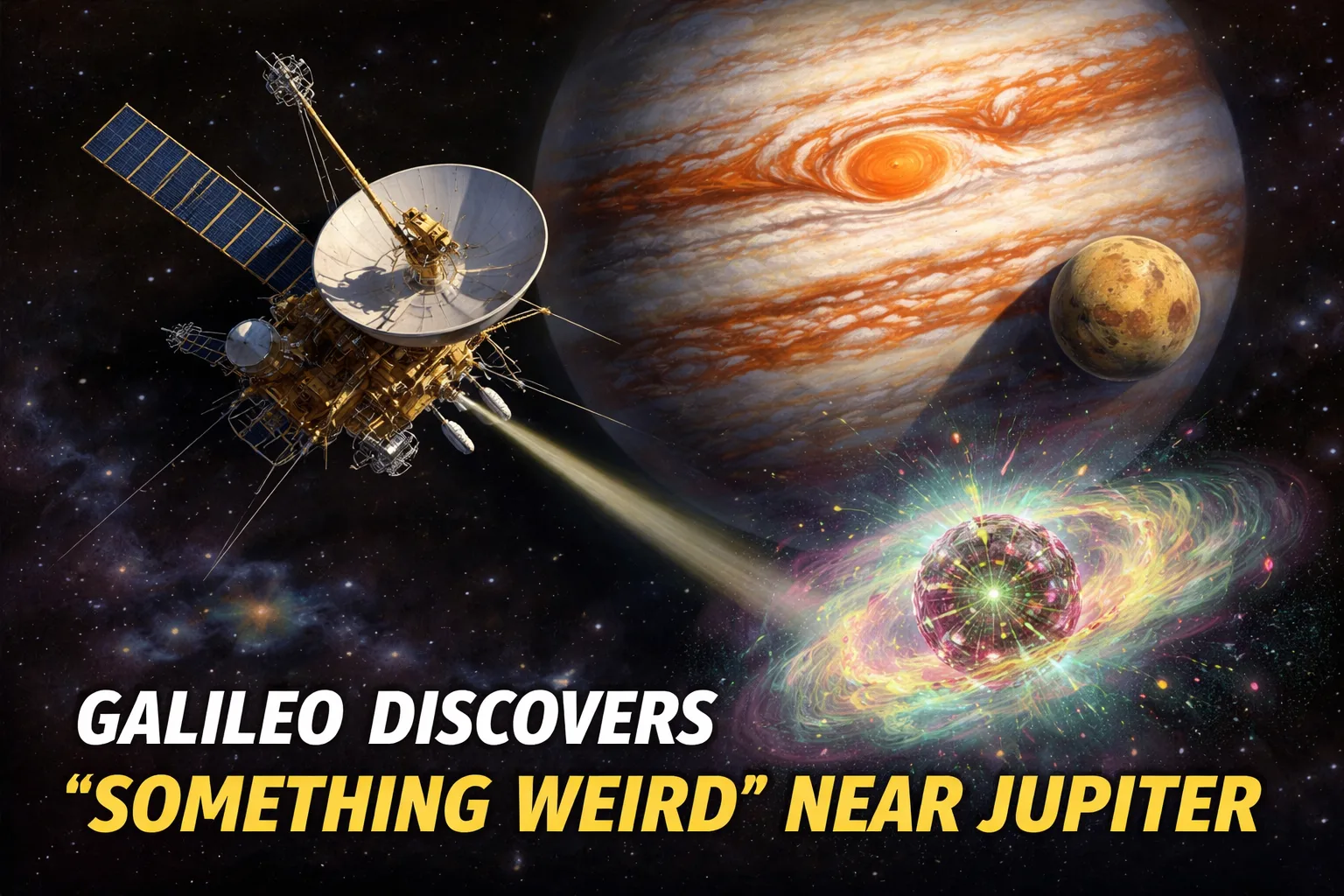
Galileo Discovers “Something Weird” Near Jupiter
Galileo

On the night of January 7, 1610, Galileo Galilei pointed his crude telescope toward Jupiter—and accidentally cracked the foundation of the universe.


On the night of January 7, 1610, Galileo Galilei pointed his crude telescope toward Jupiter—and accidentally cracked the foundation of the universe.

What he saw made no sense.

Near the bright planet were three tiny “stars”, perfectly aligned in a straight line. Galileo dutifully recorded their positions, assuming they were distant fixed stars. But when he observed them again the following night, something was wrong: they had moved. Not randomly—but in relation to Jupiter itself.

Over the next several nights, a fourth object appeared. All four lights shifted back and forth, sometimes disappearing behind the planet, sometimes reappearing on the other side. Galileo realized the impossible truth:

These objects were orbiting Jupiter.

At a time when the dominant belief—endorsed by both the Church and classical science—held that everything in the heavens revolved around Earth, Galileo had just found celestial bodies that very clearly did not.

He had discovered what we now call the Galilean moons:
Io, Europa, Ganymede, and Callisto.

This was not just an astronomical curiosity. It was a philosophical bomb.

If moons could orbit Jupiter, then Earth was no longer the unique center of motion in the universe. The discovery directly supported Copernicus’s heliocentric model, which placed the Sun—not Earth—at the center of the solar system. That idea had already been labeled dangerous, heretical, and destabilizing to both theology and social order.

Galileo knew exactly what he was holding.

He rushed to publish his findings in Sidereus Nuncius (The Starry Messenger), dedicating the discovery to the powerful Medici family to secure protection. Even so, the damage was done. The heavens—once perfect, immutable, and Earth-centered—had betrayed centuries of certainty.

The Church would tolerate Galileo’s observations… for a while.

Two decades later, he would be tried by the Roman Inquisition, forced to recant his views, and placed under house arrest for the rest of his life. Legend holds that after recanting, he muttered, “E pur si muove” — “And yet it moves.”

Whether he said it or not, the universe already had.

That cold January night in 1610 marked the moment humanity realized it was not the center of creation—just one world among many, circling silently in the dark.

Share this

Email Share on X Facebook Reddit

Did this surprise you?