
01/07/1955 • 6 views
First Atomic Clock Unveiled at US Naval Research Lab, 1955
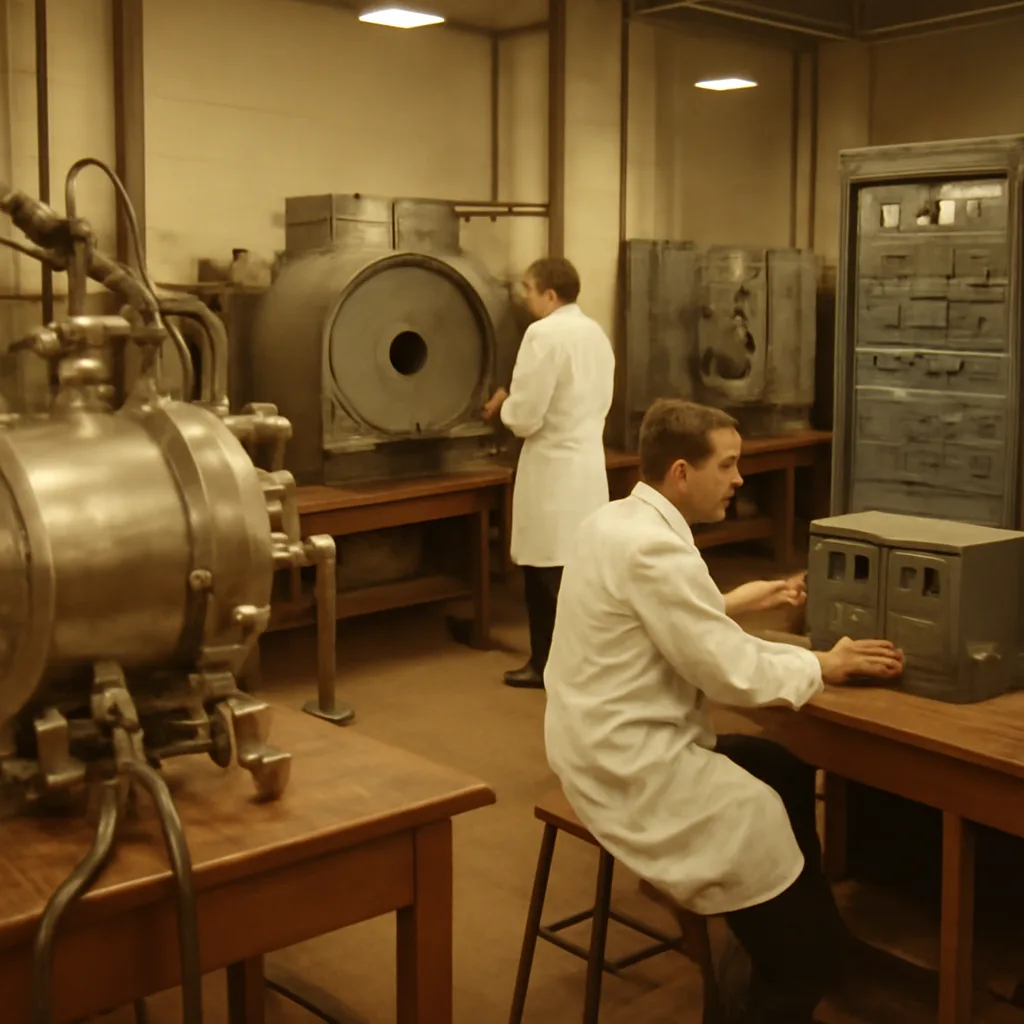
On January 7, 1955, physicist Harold Lyons and colleagues at the U.S. Naval Research Laboratory demonstrated the first practical atomic clock, using ammonia beam spectroscopy to keep time far more precisely than mechanical clocks.
Background: Before atomic clocks, timekeeping relied on mechanical pendulums, balance wheels, and later quartz oscillators. These technologies achieved impressive accuracy for many civil and scientific purposes but remained susceptible to environmental changes, wear, and drift. Mid-20th-century advances in microwave spectroscopy and radar technology, driven in part by wartime research, made it possible to observe and exploit sharply defined energy transitions in atoms and molecules as frequency standards.
The NRL device and demonstration: The first practical atomic clock demonstrated at the NRL used a beam of ammonia molecules subjected to microwave radiation. By tuning the microwave frequency to match a specific molecular transition, the apparatus produced a highly stable oscillation that could be used to regulate a clock mechanism. The demonstration showed that such an approach could surpass existing standards in stability and long-term accuracy. The NRL work was contemporaneous with other early atomic-clock research, including projects at the National Bureau of Standards (now NIST) and at institutions pursuing cesium-beam technology, which would later become the international standard.
Significance and legacy: The 1955 demonstration is significant because it proved the practicality of basing timekeeping on invariant atomic or molecular properties rather than mechanical systems. Over the following decade, refinements led to cesium-beam atomic clocks, beginning in the late 1950s and early 1960s, which provided the basis for the International System of Units (SI) definition of the second in 1967 (the second was redefined in terms of the ground-state hyperfine transition frequency of the cesium-133 atom). Atomic clocks enabled major advances in navigation, telecommunications, and fundamental physics—most notably the development of global time scales, precise satellite navigation systems such as GPS, and new tests of physical theories.
Context and caution: Multiple groups contributed to early atomic-clock research, and different devices used different atoms or molecules and experimental techniques. The NRL ammonia-beam demonstration in January 1955 is often cited as the first practical working atomic clock, but it was part of a broader, rapidly evolving field. Some sources emphasize later cesium-based devices as the pivotal technology that established atomic timekeeping standards internationally.
How it worked, in brief: The ammonia-beam clock exploited a hyperfine or rotational transition in ammonia molecules that could be induced by microwave radiation at a precise frequency. When the microwave field matched the transition frequency, the population of molecular states changed in a way that could be detected and fed back to stabilize an oscillator. This feedback produced a clock signal tied to the molecular transition frequency rather than to a mechanical resonance.
Historical impact: The arrival of practical atomic clocks transformed standards laboratories and technological systems. Within a decade of the NRL demonstration, atomic timekeeping was central to international timekeeping and to technologies requiring precise synchronization. The 1955 unveiling is therefore best understood as an early and influential milestone in the shift to atomic standards, rather than the sole origin of atomic timekeeping.
Sources and verification: The summary above synthesizes historical records of mid-20th-century developments in microwave spectroscopy and atomic frequency standards, including documented demonstrations at the U.S. Naval Research Laboratory in January 1955 and subsequent work on cesium-beam clocks that led to the 1967 redefinition of the second. Where accounts differ, historians and primary sources from standards laboratories and contemporary technical reports provide the basis for dating and describing the 1955 demonstration.