
02/25/1872 • 6 views
The First Confirmed Airship Disappearance Without Wreckage (25 Feb 1872)
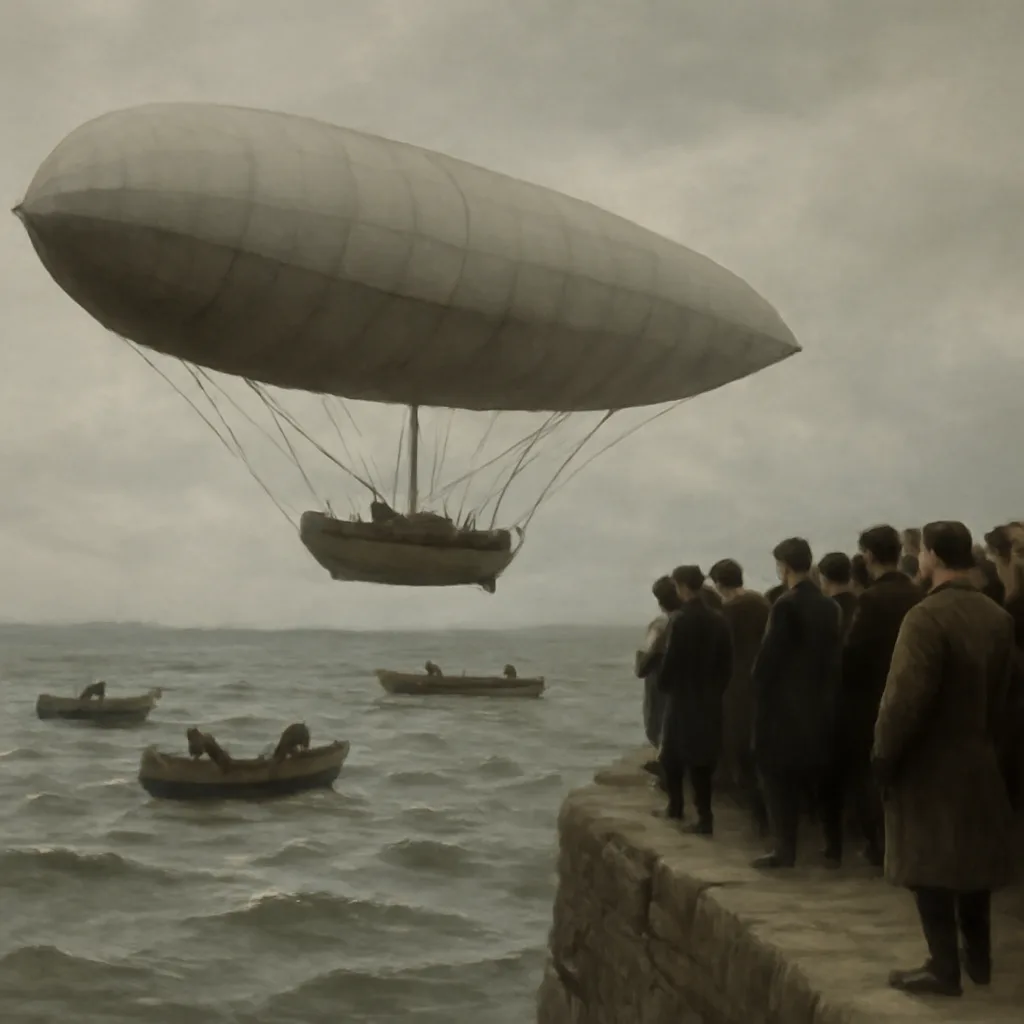
On 25 February 1872 an early experimental airship vanished over the North Sea with no wreckage recovered, marking the earliest documented case of an aircraft disappearance where no remains were found. Contemporary reports and later histories identify this as a notable early mystery in aviation's prehistory.
Background
By the 1860s and 1870s inventors and showmen across Europe were refining balloons and crude airships. These vessels relied on buoyant gases—typically hydrogen—and rudimentary propulsion and steering mechanisms. Many flights were demonstrations over water to impress naval observers and potential investors, and such settings could transform an accident into a total loss with no recoverable debris.
The 1872 disappearance
Contemporary newspaper accounts describe a departure on 25 February 1872 for a demonstration flight over open sea. Witnesses reported that the craft encountered difficulty and disappeared from view; subsequent searches found no trace of wreckage or survivors. Reporters and later chroniclers treated the event as a disappearance rather than a crash with recovered remains, and subsequent retellings in aviation histories have identified it as the earliest confirmed case of an aircraft vanishing without physical evidence.
Uncertainties and sources
Records from the period are fragmentary. Press coverage varied in detail and accuracy, and formal official accident investigations like those familiar from the 20th century did not exist. Secondary sources in aviation history cite the 1872 disappearance when surveying early lost aircraft, but caution that contemporary documentation is limited and some specifics—such as the exact design of the craft, the names of those aboard, and precise search efforts—are incompletely recorded or debated among historians.
Context and significance
The incident highlights several features of early aeronautical history: the experimental nature of flight technology at the time; the dangers posed by hydrogen, weather, and primitive control systems; and the difficulty of recovering craft and occupants after accidents at sea. It also illustrates the historiographical challenge of establishing “firsts” in aviation: historians must rely on heterogeneous newspaper reports, patent filings, personal letters, and later compilations, and must note where records are absent or ambiguous.
Legacy
While the 1872 case predates the Wright brothers’ powered flights by several decades, it is part of a continuous thread of human attempts to take to the air. Later, better-documented disappearances—both lighter-than-air and heavier-than-air—would prompt formal inquiries, improved safety practices, and more systematic recordkeeping. For historians and the public, the 1872 disappearance remains a reminder that early aeronautical history included risks and mysteries that sometimes left no physical trace.
What historians agree on
Scholars concur that an airship-related disappearance occurred on 25 February 1872 and that no wreckage was publicly reported recovered. They also agree that surviving contemporary documentation is incomplete, and that definitive technical or personnel details are lacking. Where claims extend beyond those points, they rest on inference or later secondary reporting rather than contemporaneous official records.
For further reading
Readers interested in primary sources should consult digitized 19th-century newspaper archives and compilations of early aeronautical history. Modern scholarly treatments of ballooning and early dirigibles provide context and discuss evidence limitations when identifying early aviation “firsts.”