
← Back
06/30/1972 • 6 views

The First Modern Video Game Tournament: Stanford’s 1972 Spacewar! Contest
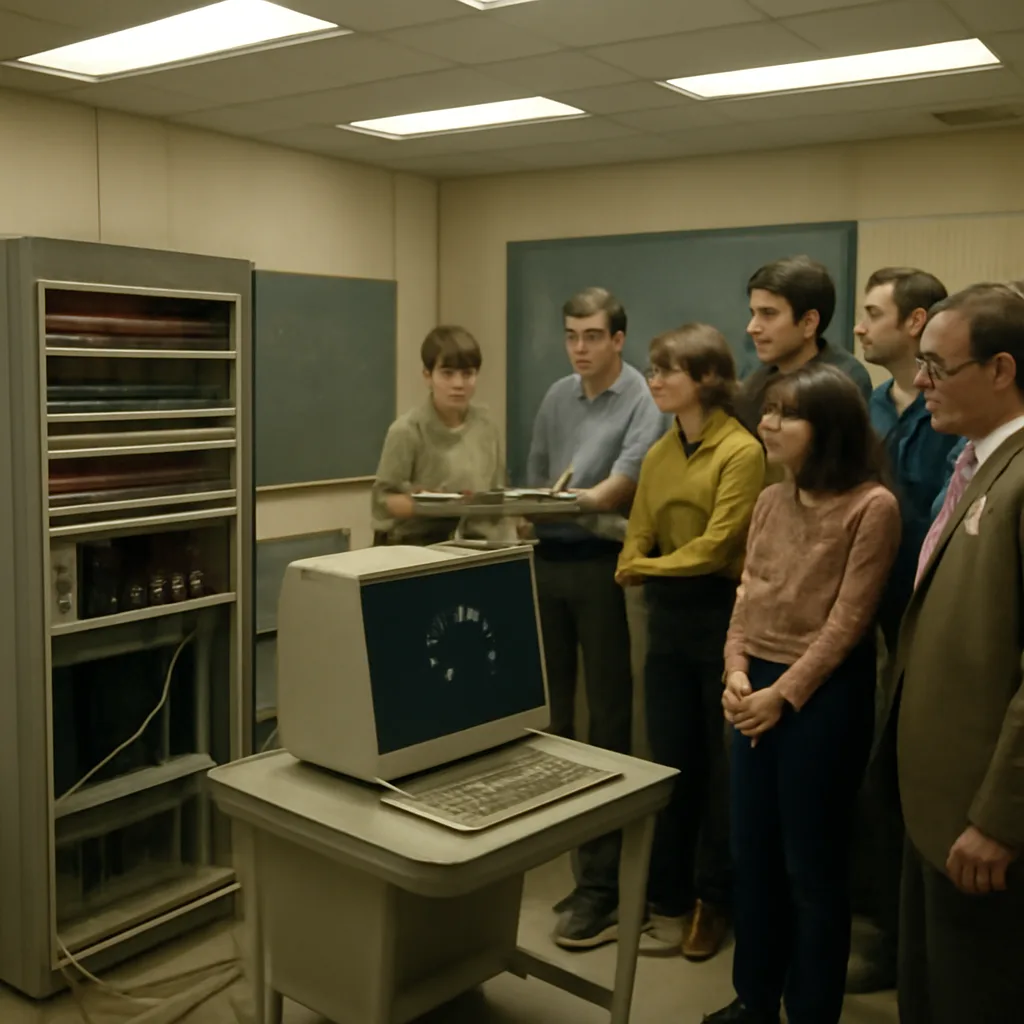
A 1970s university computing room showing a PDP-11 terminal with observers gathered around watching a two-ship Spacewar! match displayed on a vector monitor.

On June 30, 1972, Stanford hosted what is widely recognized as the first modern video game tournament, inviting players to compete on the PDP-11 running Spacewar!, a landmark event that helped define early competitive gaming culture.


On June 30, 1972, Stanford University hosted a public event often cited as the first modern video game tournament, centered on Spacewar!, a multiplayer computer game developed in the early 1960s. Spacewar! had circulated among researchers and hobbyists on PDP-series minicomputers and influenced a nascent culture of interactive electronic entertainment. The 1972 Stanford contest is notable because it brought competitive play into a public, organized setting with spectators, press attention, and a prize—a setup familiar from later gaming tournaments.

Background

Spacewar! was created in 1962 by Steve Russell and colleagues at the Massachusetts Institute of Technology for the PDP-1 computer. Over the following decade, versions of the game were ported and reimplemented on newer machines as the computing landscape evolved. By the early 1970s, university computing centers and hobbyist groups had adapted Spacewar! for machines such as the PDP-11, enabling more public demonstrations and contests.

The event

Stanford’s June 30, 1972 event took place around a PDP-11 installation at the university. Contemporary reports and later historical accounts describe a crowd of students and interested members of the public watching competitors pilot the distinctive two-ship dogfights of Spacewar!. Organizers offered a modest prize, and the format—timed matches, elimination-style play, and spectatorship—mirrored elements of modern esports tournaments. The event attracted media attention and is frequently referenced in histories of video games as a landmark moment when electronic games were framed explicitly as competitive entertainment.

Significance

The Stanford contest is significant for several reasons. It illustrates how computer games moved from isolated laboratory curiosities into public, social activities. By adopting tournament conventions—rules, a prize, spectators, and promotional framing—the event foreshadowed later commercial arcade competitions and organized esports. Historians and journalists often cite it when tracing a lineage from early mainframe and minicomputer games to the multi-billion-dollar competitive gaming industry of today.

Caveats and historiography

While the June 30, 1972 Stanford event is widely described as the first modern video game tournament, historians note caveats. Earlier demonstrations, competitions, and informal contests involving electronic games occurred at universities, research labs, and trade shows during the 1960s and early 1970s, but they often lacked the publicized tournament structure and prize element that characterize the Stanford event. Documentation from the period can be uneven: some accounts rely on newspaper clippings, personal recollections, and later retrospective reporting. Because of this, scholars generally present the Stanford tournament as a key early example rather than an uncontested, singular origin point for competitive gaming.

Legacy

The tournament’s legacy is twofold: it signaled growing public interest in interactive computer entertainment, and it provided an early template for formalized competition. Over the following decade, as arcade machines, home consoles, and personal computers proliferated, tournament formats expanded in scale and commercial backing. Histories of video games thus place the 1972 Stanford contest within a broader trajectory that moves from experimental computing projects to mainstream competitive gaming.

Sources and further reading

This summary synthesizes published histories of early computer games and contemporary reporting on university computing activities. For readers seeking primary sources or detailed archival material, university archives, period newspaper databases, and histories of Spacewar! and early PDP systems are recommended. Where specific details are disputed or sparse in the record, this account notes scholarly caution rather than asserting unverified specifics.

Share this

Email Share on X Facebook Reddit

Did this surprise you?