← Back
01/01/1801 • 9 views

The “blood rain” over Italy

blood rain

In early January 1801, residents across parts of Italy reported a phenomenon so disturbing that it immediately ignited fear


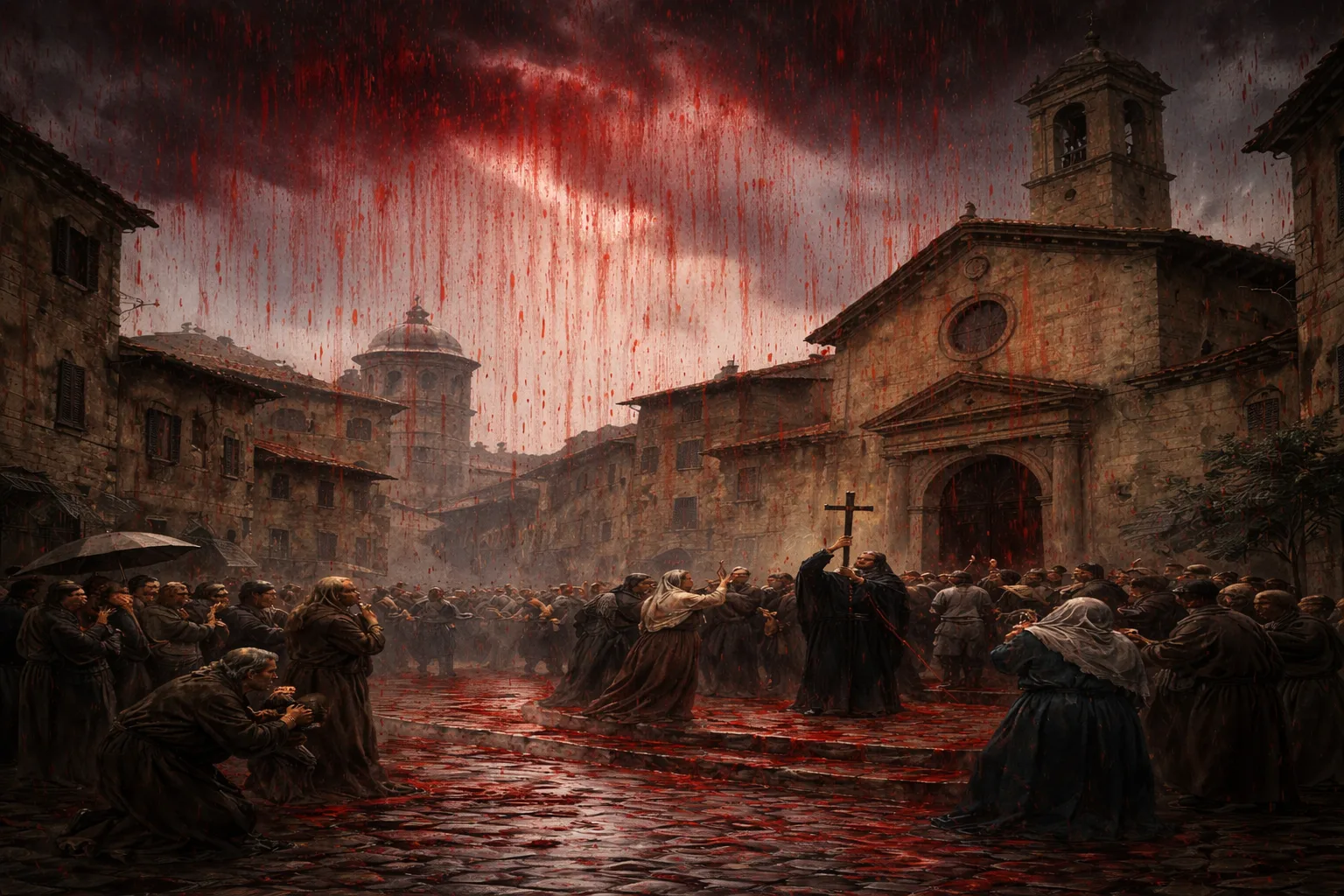
In early January 1801, residents across parts of Italy reported a phenomenon so disturbing that it immediately ignited fear, religious panic, and apocalyptic speculation: rain falling from the sky that appeared deep red, staining buildings, streets, clothing, and farmland as if soaked in blood. Occurring around New Year’s Day—a moment traditionally associated with renewal and hope—the event instead became a symbol of dread, interpreted by many as a divine warning or a harbinger of catastrophe.

At the dawn of the 19th century, Europe was still deeply shaped by religious worldviews and limited scientific understanding of meteorology. The Bible and classical texts contained references to “blood rain” as an omen of war, plague, or divine punishment, and these narratives were well known to the public. As a result, the Italian red rain was not perceived as an unusual weather event, but as a supernatural sign. Churches reportedly filled with frightened citizens, emergency prayers and masses were held, and rumors spread rapidly that famine, invasion, or the end of days was imminent.

Eyewitness descriptions emphasized the visceral shock of the event. The rain was not merely tinted; it left visible red residues on surfaces, making the comparison to blood unavoidable. In an era without modern chemistry or atmospheric science, there was no accessible explanation that could compete with religious or folkloric interpretations. Some clergy framed the event as a call for repentance, while others linked it to the political instability already gripping Europe in the wake of the French Revolution.

Modern science, however, has since provided a clear explanation. The so-called “blood rain” phenomenon occurs when fine dust particles—often originating in the Sahara Desert—are lifted high into the atmosphere by strong winds. These particles can travel thousands of miles northward into Europe. When rain clouds form and precipitation begins, the dust mixes with the water droplets, causing the rain to fall with a reddish or brownish hue. The iron oxide present in Saharan sand is responsible for the color, giving the rain its striking, blood-like appearance.

Italy, particularly its southern regions, is geographically well positioned to experience this phenomenon. Even today, Saharan dust events periodically affect Italy, Spain, France, and other parts of southern Europe. Modern instances are well documented and quickly explained by meteorologists, but the visual impact remains unsettling even to contemporary observers.

The historical timing of the 1801 event only reinforced its ominous reputation. In the years that followed, Europe plunged into the Napoleonic Wars, a series of conflicts that reshaped the continent and led to the deaths of millions. Italy itself became a major theater of war. For those who remembered the red rain, the subsequent devastation seemed to validate the belief that the heavens had issued a warning.

Reports of blood rain are not unique to Italy or to the 19th century. Ancient Roman historians recorded similar events before major disasters. Medieval chronicles often described red rain preceding outbreaks of plague. In more recent times, such as the red rain event in Kerala, India in 2001, the phenomenon has sparked intense public fascination and even fringe theories before scientific explanations prevailed.

The enduring power of blood rain lies in its ability to bridge the gap between natural science and primal fear. It is a real, measurable phenomenon, yet one that visually mimics humanity’s oldest symbol of violence and sacrifice. In 1801 Italy, that convergence of nature, belief, and historical anxiety transformed an atmospheric event into a moment of collective terror—one that remains a haunting example of how deeply humans seek meaning in the skies above them.

Share this

Email Share on X Facebook Reddit

Did this surprise you?