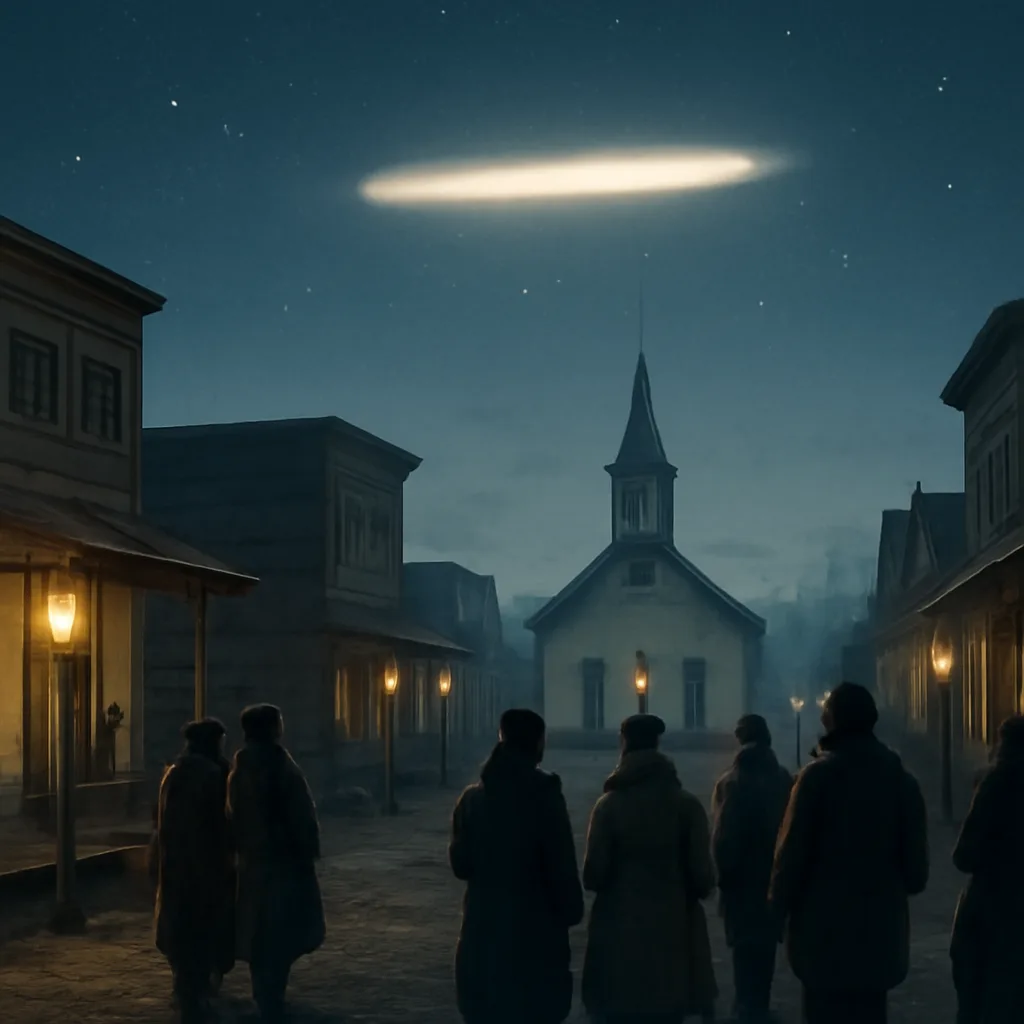
An 1878 Kansas Sighting Often Cited as the First Modern UFO Report
On January 24, 1878, several residents of Irving, Kansas, reported seeing a bright, cigar-shaped object cross the sky; contemporary accounts framed it as an extraordinary atmospheric phenomenon, and it has since been cited in histories of unidentified aerial sightings.
On the evening of January 24, 1878, townspeople in Irving, a small community in Butler County, Kansas, reported observing a bright, elongated object moving across the sky. Multiple local newspaper reports and later retellings described the object as cigar- or torpedo-shaped, luminous, and moving without the visible support of wings or propulsion familiar to observers of the era. Some accounts noted that the object emitted a bright glow and left no obvious smoke trail. The Irving sighting is often referenced by historians of anomalous aerial phenomena as an early, well-documented case from the modern period, though it sits within a longer history of unexplained aerial reports.
Contemporary sources for the Irving event are primarily local newspapers and later compilations; national outlets of the time also took interest in unusual atmospheric reports. Coverage in 1878 treated the sighting variously as a potential meteor, an optical illusion, or an unexplained occurrence. Scientific understanding of atmospheric optics, meteors, and electrical storms was less developed among the general public than today, and newspapers frequently published eye-witness descriptions without systematic verification. That mix of sincere eyewitness testimony and limited instrumentation is why historians treat such accounts cautiously.
The Irving case gained renewed attention in the 20th century when researchers cataloging early reports of unidentified aerial phenomena cited the 1878 observation as an antecedent to the later wave of sightings that began in the 1940s. These later researchers often emphasize features from the Irving descriptions—elongated shape, steady motion, and luminosity—that resemble characteristics ascribed to some modern reports. However, later interpretations must wrestle with the limitations of 19th-century reporting: sparse corroborating measurements, possible exaggeration in retellings, and the absence of photographs or physical traces.
Possible natural explanations for the Irving sighting include an unusual meteor or bolide seen at a shallow angle, an atmospheric luminescent phenomenon such as ball lightning or a rare auroral display, or optical effects caused by atmospheric refraction under particular lighting conditions. Another consideration is misidentification of conventional objects seen under unusual illumination: for example, lanterns carried by people, reflections, or even trains and industrial smoke columns observed at a distance can appear anomalous when described after the fact. No single natural explanation has been definitively established for the Irving report, and scholars generally treat it as an intriguing but ambiguous historical case.
When discussing early reports like Irving's, historians emphasize context. The late 19th century was a period of rapid technological change—telegraphy, railroads, and early atmospheric science—and popular interest in celestial phenomena was high. Newspapers often blended factual reporting with sensational elements to draw readers. As a result, while the Irving sighting is an important item in the chronology of reported unidentified aerial observations, it should not be read in isolation as proof of any particular cause.
In sum, the January 24, 1878 Irving, Kansas, sighting is a well-known early report often included in surveys of modern-era unidentified aerial phenomena. It is documented through contemporaneous newspaper accounts and later compilations, but lacks definitive physical evidence and remains open to multiple plausible explanations. Historians and scientists continue to regard it as historically significant while treating claims about its meaning with caution.