
06/16/1884 • 4 views
Coney Island's First Roller Coaster Debuts, June 16, 1884
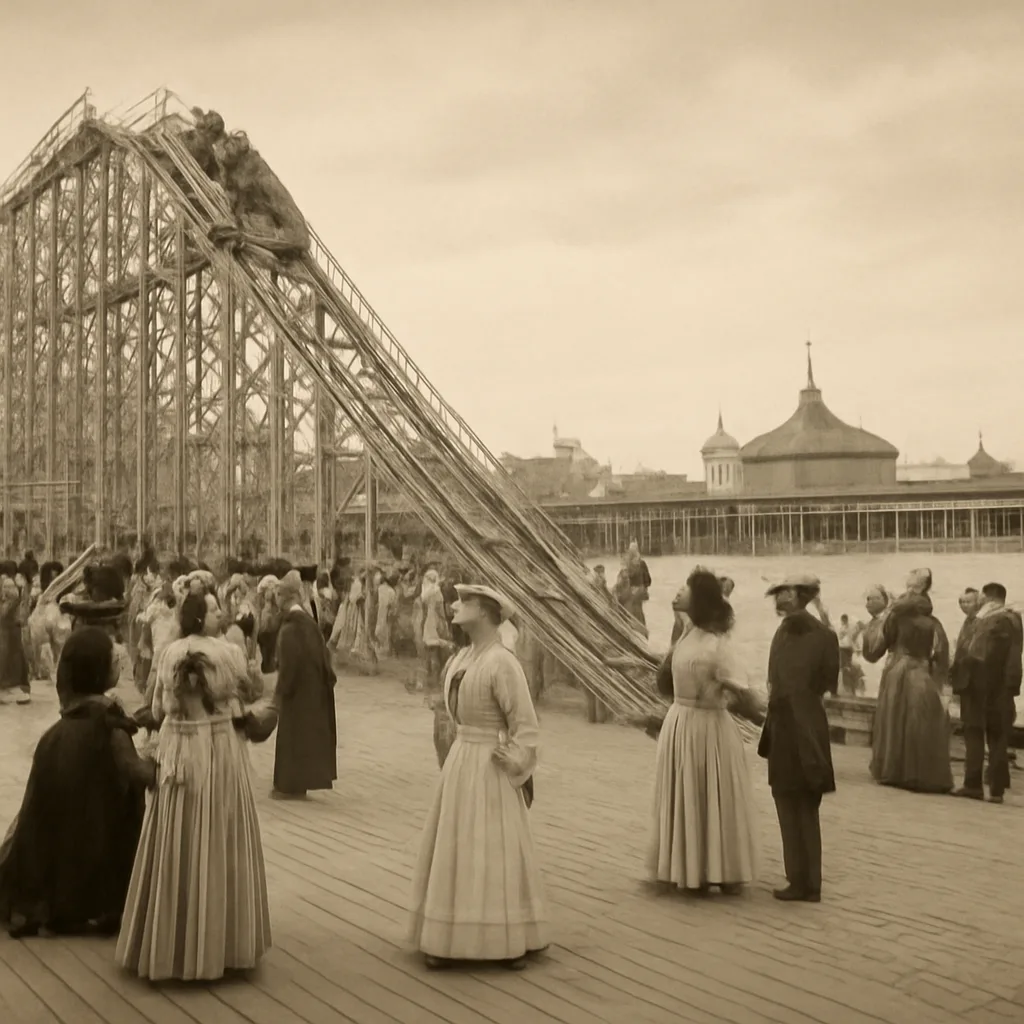
On June 16, 1884, a gravity-powered roller coaster—often cited as the first of its kind in American amusement—opened at Coney Island, marking an early milestone in the development of modern amusement parks.
Historical context
Coney Island in the 1880s was evolving from a seaside resort into an entertainment district. Excursions by ferry and rail brought urban visitors to its beaches and amusements. Inventors and entrepreneurs experimented with mechanical rides, panoramas, simulated travel experiences and live shows to attract crowds. The roller coaster was one of several mechanical amusements that sought to provide thrills safely to families and working-class patrons who flocked to the area.
The ride and its mechanics
Descriptions from period newspapers and trade publications identify the 1884 attraction as a gravity railroad or scenic railway employing raised tracks, wheeled cars, and a means of returning cars to the start—often via an inclined plane or a lift mechanism. Cars were guided along wooden or iron rails and relied on an initial ascent followed by a downhill run to produce speed. Early safety practices and restraints were rudimentary by modern standards; operators emphasized controlled speed and track design to reduce risk.
Attribution and disputes
Multiple claims and later retellings have created some ambiguity about which installation should be called the “first” roller coaster in America. Earlier gravity railways existed for mining and industrial uses and some pleasure rides in Europe preceded Coney Island’s. The 1884 Coney Island installation is, however, widely cited in American sources as the first prominent, commercially operated gravity-powered amusement railway in the United States designed primarily for passenger thrills rather than practical transport. Because contemporary reporting used varying terminology—“scenic railway,” “gravity railroad,” “roller coaster”—historians distinguish between technological precedents and the popular, commercial amusement form that emerged at Coney Island.
Cultural impact
The ride’s debut contributed to Coney Island’s reputation as a testing ground for amusements, encouraging further innovations in ride design and park layout. In the decades that followed, designers expanded on the basic gravity-railway concept, introducing taller structures, steel supports, corkscrews and mechanized lift systems that became hallmarks of modern roller coasters. The popularization of such rides helped crystallize the amusement park as a mass entertainment institution in the United States.
Legacy and preservation
No single original 1884 structure survives intact at Coney Island, and later development and replacement of attractions have erased many early rides. Documentation survives in period newspapers, trade journals and photographs that record the appearance and public response to early roller coasters. Historians use these contemporary sources to trace the technological and cultural evolution from the 1884 installation to the multi-loop steel coasters of the 20th and 21st centuries.
Conclusion
While earlier industrial gravity railways and European pleasure railways informed the technology, the June 16, 1884 attraction at Coney Island remains an important early example of the roller-coaster form in American popular culture. It helped establish design principles and popular appetite for thrill rides that would shape amusement parks for generations. Where exact claims about singular “firsts” persist, scholars note that the significance lies as much in the ride’s role in popularizing the form as in any absolute technical primacy.