
← Back
06/04/1890 • 4 views

Court Upholds First Use of Electric Chair in 1890
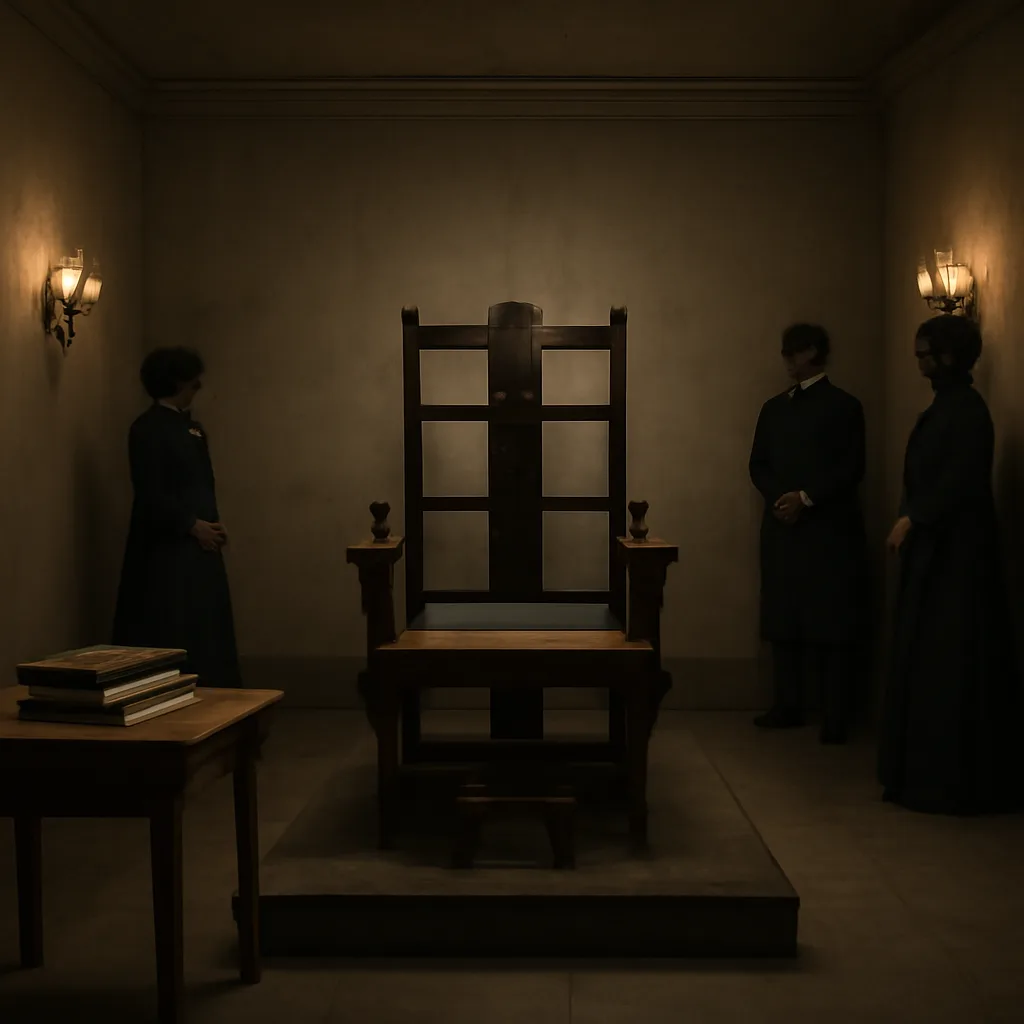
Late 19th-century execution chamber interior with an early electric chair on a platform, dim gaslight, attendants in period clothing, and legal documents on a nearby table.

On June 4, 1890, a U.S. court affirmed the legality of the electric chair’s initial application, cementing a controversial new method of execution that emerged amid late-19th-century debates over humane punishment and technological progress.


On June 4, 1890, legal authorities upheld the first application of the electric chair, a ruling that helped establish electrocution as an accepted form of capital punishment in the United States. The electric chair had been developed in the 1880s as an alternative to hanging, promoted by proponents who argued it was more humane and modern. Its introduction sparked immediate legal, moral, and technical controversy, with opponents questioning both its humanity and its constitutionality under prohibitions against cruel and unusual punishment.

The device was the product of state-level efforts—most notably in New York—to find alternatives to public hangings, which had become increasingly unpopular. Inventors and physicians participated in experiments intended to determine the appropriate voltage and duration of current to cause rapid death. These experiments were far from uniform and produced disputed accounts of suffering and botched procedures during early uses.

The June 4, 1890 decision came in the wake of litigation challenging the method. Opponents brought cases arguing that electrocution violated constitutional protections against cruel punishments. Courts faced the novel question of whether death caused by electrical current fit within existing legal frameworks governing execution methods. In upholding the first use, judges relied on available medical testimony, legislative authority, and evolving standards of what constituted acceptable methods of execution. The ruling effectively allowed states to proceed with electrocution as an authorized method.

By affirming the legitimacy of the electric chair, the decision influenced the spread of electrocution across other states. During the following decades, many jurisdictions adopted the electric chair as their primary execution method. This period also saw continued scrutiny: botched executions, conflicting medical testimony, and public protests ensured electrocution remained controversial. Legal challenges persisted, sometimes succeeding in delaying or modifying practices, and the question of what constituted "cruel and unusual" treatment continued to evolve through case law.

Historians note that the adoption of the electric chair reflected broader trends of the era—the faith in technological solutions to social problems, professionalization of penal systems, and shifting public attitudes about the spectacle of punishment. The device’s introduction did not end debate; rather, it relocated disputes from the public square and gallows to courtrooms, medical journals, and legislative halls.

Over the 20th century, electrocution itself eventually came under renewed legal and ethical scrutiny, particularly as other methods such as lethal injection emerged. Many of the same constitutional arguments—centered on the Eighth Amendment’s prohibition of cruel and unusual punishment—were revisited as medical evidence and societal standards changed. As a result, several states moved away from the electric chair, and some retained it only as a secondary or optional method.

The June 4, 1890 ruling stands as a significant judicial moment in the history of American capital punishment: it endorsed a new technology-driven approach to execution and set legal precedent used to justify electrocution for decades. While the decision did not settle the broader moral debates, it marked the moment when courts formally permitted a marked shift in execution practice, one that would shape penal policy and public controversy for generations.

Note: Specific court names and case citations related to this date vary in historical records; where precise case identifiers are in dispute or not universally cited, scholars reference contemporaneous litigation and legislative records documenting early judicial approvals of electrocution in the late 1880s and 1890s.

Share this

Email Share on X Facebook Reddit

Did this surprise you?