
← Back
02/05/1914 • 5 views

First Electric Traffic Light Installed in Cleveland, 1914
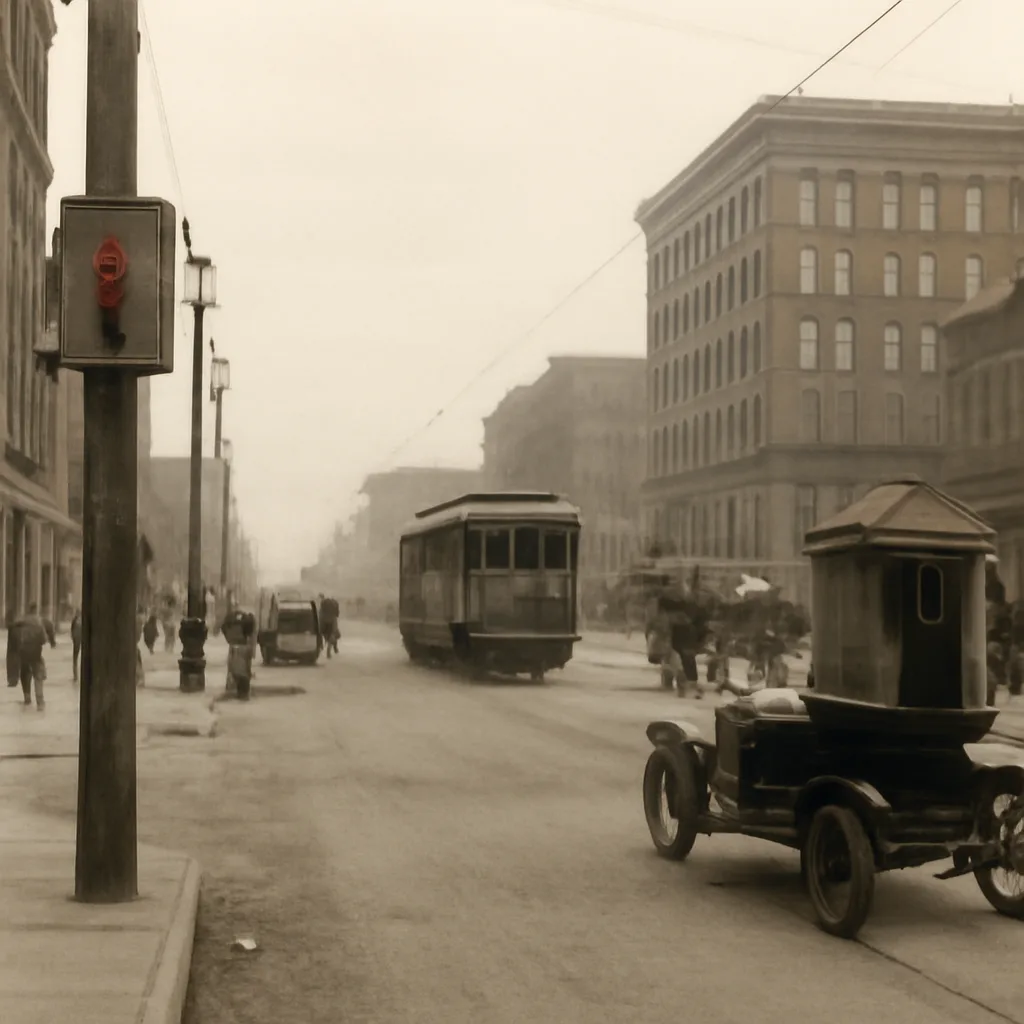
A 1914 urban street intersection in Cleveland with early automobiles, streetcars, pedestrians, and a wooden pole-mounted two-color electric traffic signal box visible near a storefront.

On February 5, 1914, Cleveland introduced the first electric traffic signal, a two-color electric light mounted at an intersection to manage growing automobile and streetcar traffic—an early step toward modern traffic control.


On February 5, 1914, Cleveland, Ohio, saw the installation of what is widely recognized as the first electric traffic signal in the United States. The device was mounted outside the H. P. Nelson Grocery store at the intersection of East 105th Street and Euclid Avenue, an area experiencing heavy congestion from automobiles, horse-drawn vehicles, and streetcars. Designed to make street traffic safer and more orderly, the signal was a two-color electric light—red and green—operated manually by a police officer from a nearby booth.

Background and context
The early 20th century brought rapid increases in urban traffic as automobiles proliferated alongside existing horse-drawn conveyances and street railways. Cities experimented with various traffic-control measures, including policemen directing flow, semaphore signals, and flagmen. Before Cleveland’s electric installation, there had been prior experiments with mechanical and gas-lit signals in other places; for example, a semaphore-style electric signal had been installed in London in the 1860s, and in the United States, earlier efforts at timed or mechanical signals were attempted. However, Cleveland’s 1914 installation is commonly cited in contemporary and later accounts as the first electric traffic light intended for regular street use in the U.S.

Design and operation
The Cleveland device used two oil-lamp-sized electric lights—red for stop and green for go—housed in a wooden box mounted on a pole. The signal was controlled by an attendant (a police officer) who turned the lights on and off according to observed traffic conditions. It was not automated; manual operation reflected the technological and regulatory realities of the era. The goal was practical: reduce collisions and improve the flow at a busy commercial intersection.

Impact and subsequent developments
The Cleveland installation attracted local attention and demonstrated the potential of electric signaling for traffic management. Within a few years, other cities began to adopt electric lights and explore more sophisticated arrangements, including three-color signals (adding yellow for caution) and mechanical or timed changes. Notably, Garrett Morgan received a patent for a traffic signal with a third “caution” position in 1923, and automated, timed signals were developed through the 1920s and 1930s. Over time, signals evolved into standardized, centrally coordinated systems integral to urban transport infrastructure.

Historiography and caveats
Histories of traffic signaling sometimes differ over what should count as the “first” electric traffic light because of varying definitions (e.g., experimental vs. regularly used installations, semaphore vs. electric illumination). The 1914 Cleveland device is well-documented in American contemporary accounts as the first regularly used electric traffic signal in the United States, but earlier or parallel experiments occurred elsewhere. Where exact claims are disputed, sources typically note distinctions in form and usage rather than denying Cleveland’s role in the transition to electric signaling.

Legacy
The February 1914 installation marks an early, concrete step toward the complex traffic-control systems in use today. From manually operated electric lights, cities moved to timed, multi-color signals, then to computerized coordination and sensor-based control. The Cleveland signal is remembered not only as a technological innovation but as a reflection of cities adapting to the mobility changes of the automobile age.

Sources and further reading
Contemporary newspaper coverage from Cleveland in February 1914 records the installation and its local purpose; later historical surveys of traffic engineering and urban transportation likewise cite the Cleveland installation when tracing the early adoption of electric traffic lights in the United States.

Share this

Email Share on X Facebook Reddit

Did this surprise you?