
← Back
05/05/1973 • 12 views

First Public Demonstration of a Humanoid Robot, May 5, 1973
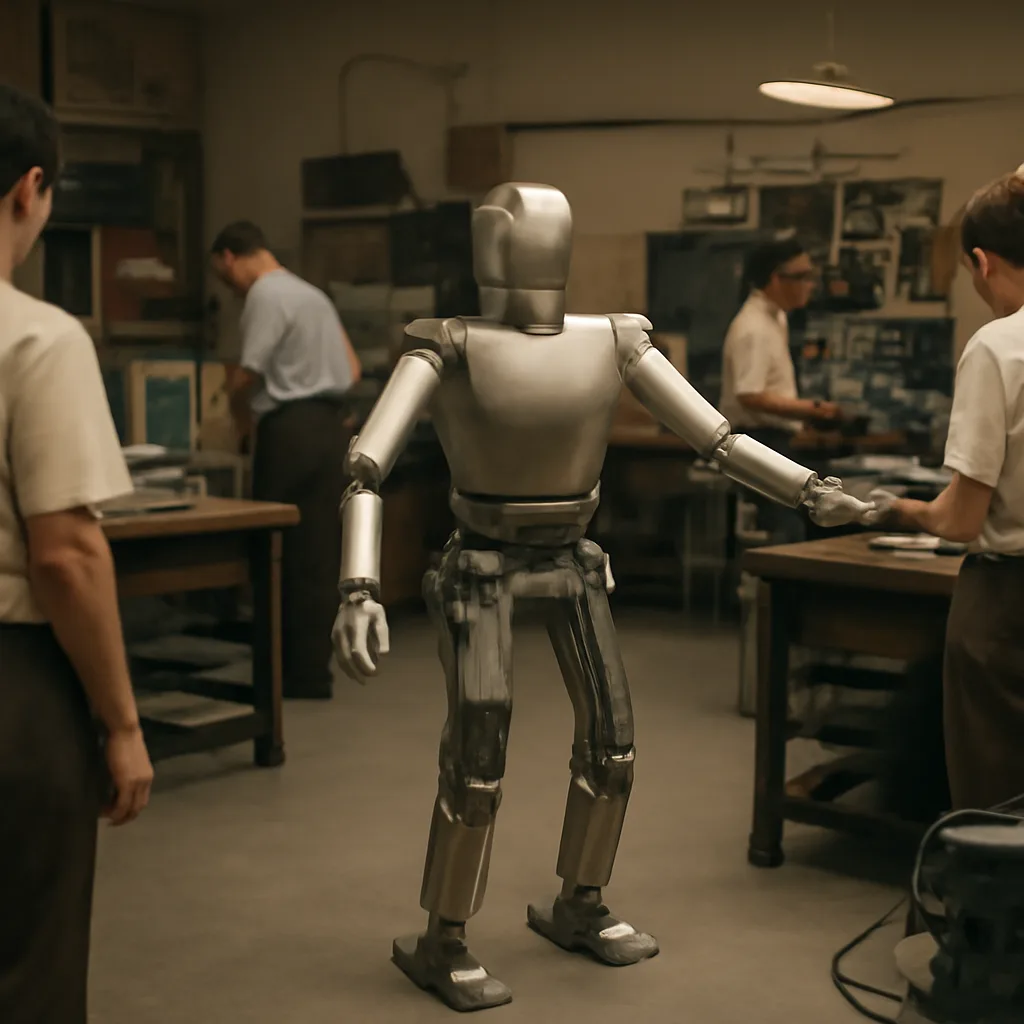
A 1970s laboratory scene showing a humanoid-shaped robot with torso and limbs performing simple movements amid engineers and equipment of the era.

On May 5, 1973, engineers presented the first widely publicized demonstration of a humanoid robot, marking an early public glimpse into human-shaped machines designed to mimic basic human movements and tasks.


On May 5, 1973, a public demonstration showcased a humanoid robot—an articulated machine built to approximate human form and motion—bringing the concept of human-shaped automation to wider attention. The event occurred in the early 1970s context of growing interest in robotics across universities, corporate laboratories, and government-funded research programs in the United States, Europe, and Japan. Researchers were then transitioning from industrial manipulators and theoretical work to machines that explored locomotion, manipulation, and anthropomorphic design.

The 1973 demonstration featured a robot with a torso, limbs and a head-like structure capable of limited, preprogrammed movements such as grasping simple objects, rotating a shoulder or elbow joint, and turning its head. Power and control systems of that era relied on bulky actuators, pneumatic or electric motors, relays and early analog or rudimentary digital controllers, so the machine’s motions were slow and deliberately constrained. The demonstration emphasized the potential for humanoid forms to interact with environments designed for people—an argument that helped motivate subsequent research on dexterous hands, balance and bipedal locomotion.

This event should be understood within technical and social contexts of the time. During the late 1960s and early 1970s, robotics research concentrated on industrial arms for manufacturing; at the same time, laboratories experimented with mobile robots, sensor systems and computer vision. The humanoid demonstration drew public and media interest because a humanlike silhouette made the technology more relatable than the articulated arms commonly seen on factory floors. That relatability helped shape public expectations and funding priorities, though many technical challenges remained unresolved: compact power sources, high-performance actuators, reliable sensing and real-time control were still limited.

Historical accounts of early humanoid demonstrations are not always uniform in detail. Different institutions staged prototypes with varying capabilities and publicity; some demonstrations were limited to academic audiences, while others were arranged for press coverage. Documentation from the period—conference proceedings, technical reports and contemporary news articles—provides the primary record, but these sources can vary in completeness and emphasis. Where definitive attribution or exact technical specifications are not consistent across sources, researchers typically rely on contemporaneous engineering publications and archival materials to reconstruct events.

The legacy of the 1973 public demonstration is visible in later developments: efforts to build more dexterous hands, research into dynamic balance for walking robots, and the rise of humanoid platforms in university labs and industrial R&D during the 1980s and 1990s. Engineers and designers drew lessons from early public demonstrations about human–machine interaction, safety and the social framing of robots. Over subsequent decades, improvements in microprocessors, materials, actuators and sensors enabled more capable humanoid systems, though many fundamental challenges identified in the 1970s persisted.

In summarizing the 1973 demonstration, it is important to avoid overstating immediate technical achievements or implying a direct, uninterrupted line to contemporary humanoid robots. The demonstration was a milestone in public exposure to anthropomorphic machines and helped catalyze interest and investment, but progress unfolded through numerous incremental advances across many groups and decades. For verifiable specifics about particular prototypes or institutions involved in early humanoid work, consult primary sources from robotics conferences, engineering journals and archival news reports from the early 1970s.

Share this

Email Share on X Facebook Reddit

Did this surprise you?