
02/22/1945 • 6 views
First successful artificial kidney treatment, 22 February 1945
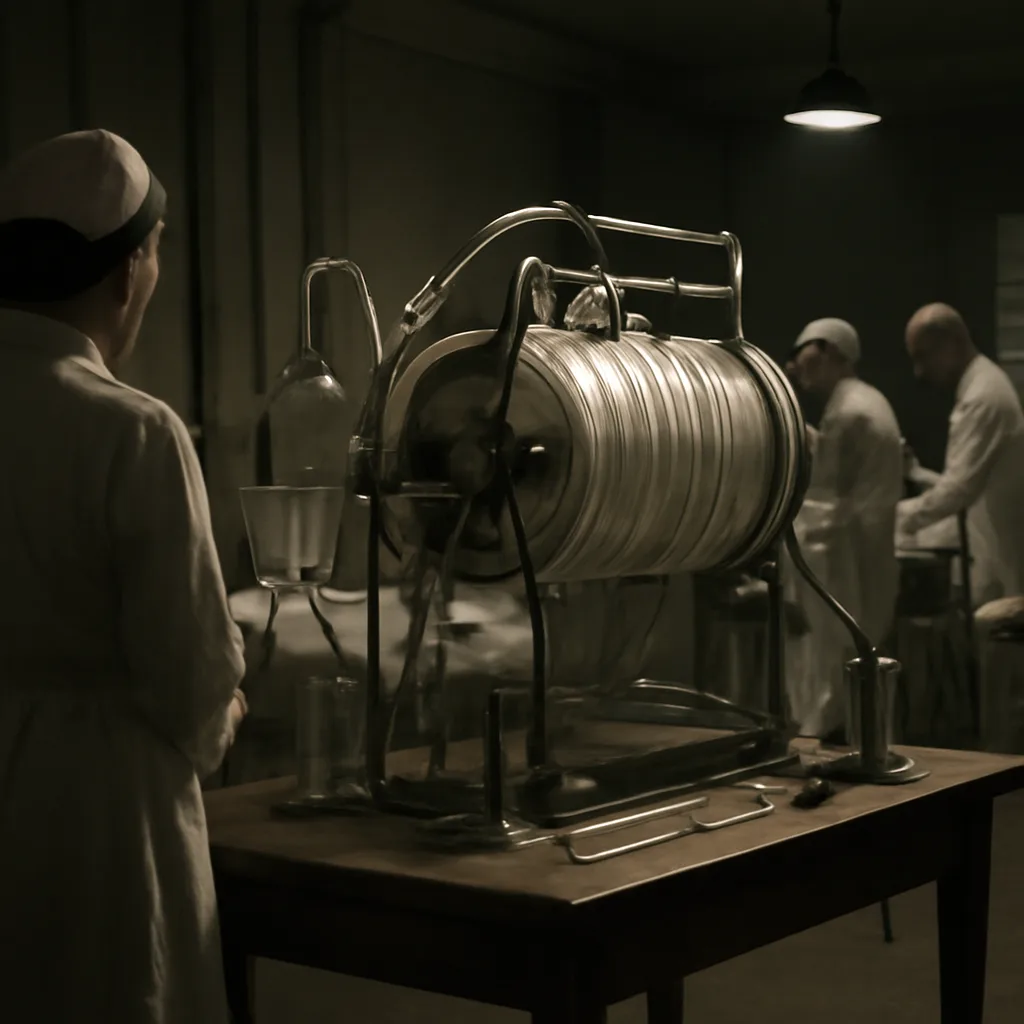
On 22 February 1945, Dr. Willem Kolff reported the first successful clinical use of a rotating drum artificial kidney—an early dialysis machine—that sustained a patient's life by removing toxins and excess fluid when their kidneys failed.
Kolff had been developing prototype devices since about 1943, inspired by the concept of dialysis: diffusion of solutes across a semi-permeable membrane to remove waste products such as urea from the blood. By 1945 he refined a design in which a long coil of cellophane tubing, containing the patient’s blood, was slowly rotated through a tank of dialysis fluid on a wooden drum. This arrangement increased the surface area for diffusion while minimizing clotting and heat loss. The device removed uremic toxins and excess water, offering a temporary replacement for lost kidney function.
The 22 February 1945 case is notable because it demonstrated that the technique could sustain life long enough to be clinically meaningful. Reports from Kolff and later historical reviews indicate that several patients were treated successfully with his machine during the final months of World War II. These early treatments were technically difficult, required careful anticoagulation and monitoring, and were not yet the standardized, safe procedures dialysis patients receive today.
Kolff’s work built on prior physiological and engineering research into dialysis membranes and blood purification, but his wartime circumstances—limited supplies and acute clinical need—drove practical innovation. After the war he continued development and shared his designs internationally, influencing later machines that became the basis for chronic hemodialysis and renal replacement therapy. Over subsequent decades, improvements in membrane technology, vascular access, anticoagulation, fluid balance management, and dialysis machines themselves made the treatment safer, repeatable, and widely available.
Historical accounts caution that while 22 February 1945 is commonly cited as the date of Kolff’s first successful clinical use, the early history involves multiple patients, iterative experiments, and contributions from other researchers in physiology and surgery. The achievement is best understood as a pivotal moment in a broader, collaborative progression toward modern dialysis rather than a single isolated invention.
Kolff later emigrated to the United States and continued work in artificial organs, and his rotating drum kidney is preserved in medical history as a foundational step in renal replacement therapy. The development transformed a previously fatal condition—acute uremia—into a treatable one and eventually paved the way for long-term dialysis programs and kidney transplantation in the latter half of the 20th century.