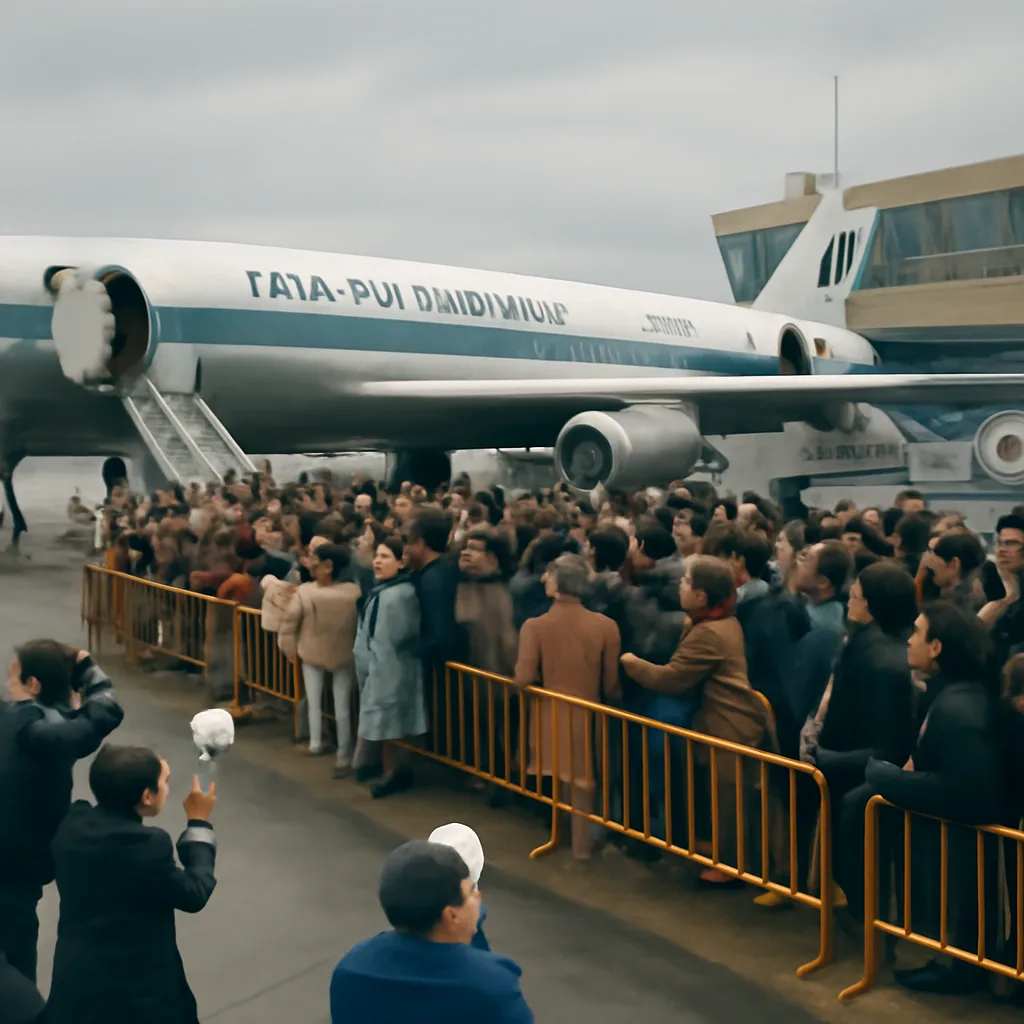
Beatlemania Lands in America: The Beatles Arrive in New York, February 7, 1964
On February 7, 1964, The Beatles arrived at New York’s John F. Kennedy Airport, touching off an unprecedented wave of public excitement and media attention that came to be called "Beatlemania." Their arrival marked a rapid shift in American popular culture and the start of the British Invasion.
On the afternoon of February 7, 1964, the British rock band The Beatles — John Lennon, Paul McCartney, George Harrison and Ringo Starr — landed at New York’s John F. Kennedy Airport aboard a chartered Pan Am jet. Their appearance, following a transatlantic flight from London, attracted a large crowd of fans and reporters and signalled the start of a week that would redefine popular music in the United States.
The Beatles had already achieved significant chart success in the United Kingdom and parts of Europe. In the weeks before their arrival, several of their singles and the self-titled U.S. album (released as Meet the Beatles! in America) had begun charting, helped by growing radio play and coverage in British and American music press. Press and promoters in the U.S. organized the group's visit around a high-profile television appearance and live performances, most notably on The Ed Sullivan Show.
At JFK, the band’s arrival was met by hundreds of fans and dozens of journalists. News reports and contemporary photographs show young people gathered in the terminal and on the tarmac, some visibly excited and others overwhelmed by the crush. Airport authorities and police worked to control the crowds; the scene contributed to the narrative of "Beatlemania"—a term already in use in Britain to describe intense fan reactions to the group. Media coverage emphasized both the scale of the fans’ enthusiasm and the logistical challenges of managing it.
The publicity surrounding the arrival was immediately amplified by television and print media. The Beatles’ appearance on The Ed Sullivan Show on February 9 drew an estimated 73 million viewers and is widely viewed as the pivotal moment that brought them into the mainstream of American popular culture. Their week in the U.S. also included a concert at Washington, D.C.’s Coliseum (February 11) and their first U.S. concert at the Washington Coliseum on that date, plus a later performance at Shea Stadium in August 1965 that further underscored their commercial impact.
The phenomenon had broader cultural implications. Record sales for British acts rose, and American radio stations increased airplay for rock and pop records, accelerating what commentators called the "British Invasion"—a wave of UK-based musicians achieving popularity in the U.S. The Beatles’ arrival also influenced fashion, youth culture, and the structure of the music industry, prompting changes in concert promotion, merchandising, and media coverage of popular music.
Scholars and journalists have noted that the reaction combined genuine enthusiasm for the band’s songwriting and sound with the social dynamics of youth identity and mass media. Contemporary accounts describe both ecstatic fan behavior and critical commentary that questioned the scale of the attention. Historians emphasize the role of television in transforming a touring visit into a national cultural event: the Ed Sullivan broadcast gave millions simultaneous exposure to the group, magnifying the effect of their physical arrival.
Not all aspects of the event are uniformly documented. Estimates of crowd size, the intensity of reactions, and the precise sequence of activities around the airport vary across contemporary reports. But the broad consensus among historians and music scholars is clear: The Beatles’ arrival in the U.S. in February 1964 catalyzed a major shift in American popular culture, heralded the British Invasion, and left a lasting imprint on the global music industry.
This moment is remembered both for its immediate spectacle — screaming fans, dense media coverage, and packed television audiences — and for its longer-term cultural consequences: a rapid internationalization of pop music, shifts in youth culture, and the elevation of rock bands to a new level of commercial and cultural prominence.