
← Back
06/26/1945 • 4 views

Delegates Sign the United Nations Charter in San Francisco, 1945
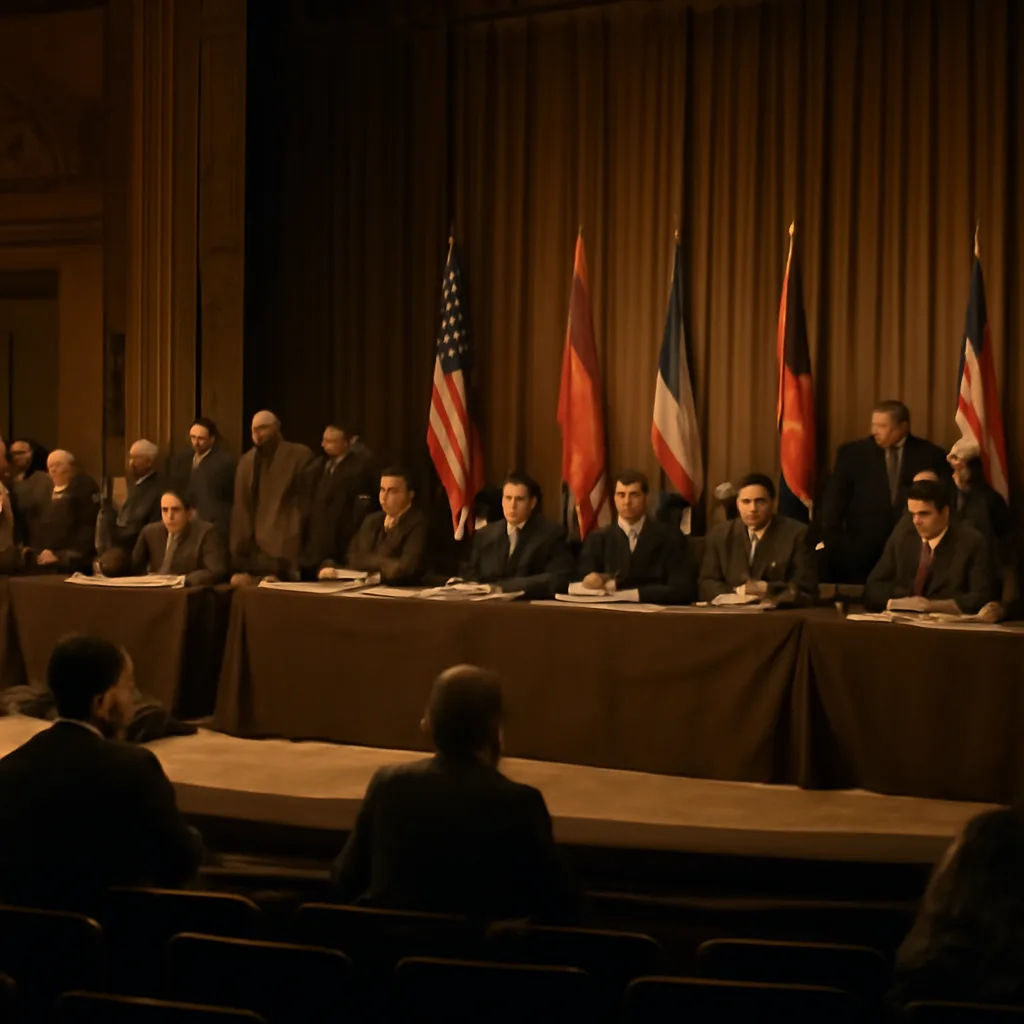
Delegates seated and standing in the San Francisco Opera House during the signing of the United Nations Charter in June 1945, with documents and flags displayed on stage.

On June 26, 1945, delegates from 50 Allied nations signed the United Nations Charter in San Francisco, formally creating the UN and signaling a new framework for international cooperation after World War II.


On June 26, 1945, representatives of 50 Allied nations gathered at the San Francisco Opera House to sign the United Nations Charter, the founding treaty of the United Nations. The Charter had been negotiated and drafted during the United Nations Conference on International Organization, which convened in San Francisco from April 25 to June 26, 1945. The conference built on earlier wartime declarations—most notably the Atlantic Charter and the Declaration by United Nations (1942)—and on plans developed at the Yalta Conference earlier that year. The aim was to create a durable international organization to prevent future global conflict, promote human rights, and facilitate cooperation on economic and social matters.

The San Francisco conference was notable both for its size and for its diversity of participants. Delegates represented not only the major Allied powers—the United States, the Soviet Union, the United Kingdom, China, and France (the latter later confirmed as a permanent Security Council member)—but also smaller Allied states and colonial territories whose representatives attended in varying capacities. The delegates debated provisions on collective security, the structure and powers of the Security Council and the General Assembly, and mechanisms for dispute resolution. Contentious issues included the veto power granted to permanent Security Council members, representation and status of colonies and non-sovereign peoples, and procedures for amending the Charter.

The signings in late June followed intense negotiations and compromise. The final Charter established principal organs—the General Assembly, Security Council, International Court of Justice, Economic and Social Council, Trusteeship Council, and Secretariat—and outlined their functions. It affirmed principles such as the sovereign equality of member states, the peaceful settlement of disputes, the prohibition of the use of force except in self-defense or under Security Council authorization, and commitments to human rights and social and economic development. Ratification by a specified number of signatory states, including the permanent Security Council members, was required for the Charter to enter into force.

The Charter formally came into force on October 24, 1945, after the necessary ratifications were deposited; that date is now observed annually as United Nations Day. The 1945 San Francisco signing is widely regarded as a pivotal moment in the development of postwar international institutions. It marked a collective effort by states exhausted by war to create rules and institutions intended to manage interstate relations and reduce the likelihood of another global conflict. However, contemporary and subsequent critics noted limits and contradictions in the Charter: the Security Council veto reflected great-power politics, and decolonization, Cold War rivalry, and differing interpretations of sovereignty and human rights would shape how the UN functioned in practice.

Historical records of the conference are preserved in official documents, conference proceedings, and the UN Archives. The San Francisco setting—the restored War Memorial Opera House—served as the public stage for the ceremonial signing. The event combined formal ceremony with the technical legal work of treaty drafting and left a legal and institutional framework that endures, albeit adapted through amendments, the growth of membership, and evolving international norms.

The signing on June 26, 1945, therefore represents both a legal milestone—the adoption of a multilateral treaty creating a new international organization—and a symbolic commitment by its founders to pursue collective mechanisms for peace, security, and cooperation in the aftermath of World War II.

Share this

Email Share on X Facebook Reddit

Did this surprise you?